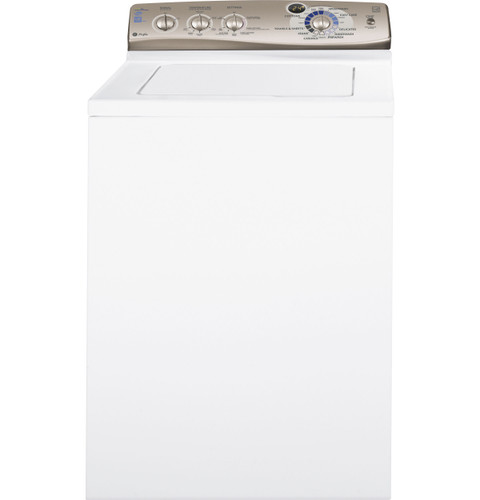
GE Profile PTWN6250M / PTWN6250MWT HydroWave Infusor washer
PTWN6250M washer specifications and wash-system behavior
The GE Profile PTWN6250M is listed as a 3.6 DOE cu. ft. high-efficiency top-load washer with a stainless-steel basket, HydroWave system and Infusor wash action. The specification sheet lists 700 RPM spin and PreciseFill automatic load sensing. Those are details of this older design, not a current Profile washer.
Expect different water movement from a conventional agitator washer. The supplied quick reference says water may not cover clothes and quiet pauses or “swoosh” sounds can be normal parts of HydroWave/Infusor operation.
- Use HE detergent and load loosely around the Infusor.
- Expect low visible water, sensing pauses and variable estimated time as documented behavior.
- Use the cycle’s spin behavior when judging remaining moisture.
Capacity and basket
GE lists capacity at 3.6 DOE cubic feet and identifies a stainless-steel basket. Load loosely around the Infusor rather than compressing clothes to fill the basket edge-to-edge. The manual warns that overloading the Infusor reduces wash performance; bulky pieces should not be packed so tightly that they cannot move through the water.
The 700 RPM figure is a specification, not a promise that every cycle reaches that spin speed. The cycle chart pairs some cycles with fast spin and others with slow or extra-slow spin. Clothing that is wetter after Delicates or Hand Wash than after Cottons is consistent with the documented cycle design.
HydroWave, Infusor and low-water expectations
The specification sheet describes HydroWave with HE LoWater wash and Infusor. The quick reference explains that this uses less water than a conventional top-loader; water may not cover the tops of clothes. The Infusor moves the load through concentrated wash action, so an older washer’s waterline is not the right comparison.
Use HE detergent and measure it for load size, soil and water softness. Excess suds can interfere with rinsing and leave residue. The owner manual advises less detergent for soft water, smaller loads or lightly soiled items. Do not use ordinary non-HE detergent to force suds or a higher water level.
PreciseFill and cycle timing
The product sheet lists PreciseFill, which measures the load and adds an appropriate amount of water. Automatic sensing starts only with the lid closed; with the lid open, the washer does not fill during sensing. At startup, sensing can be quiet and include pauses before the wash action begins.
The remaining-time display is approximate and can change because fill time depends on household pressure. The manual says the timer learns the washer’s fill duration and adjusts total time. A changing estimate during initial fill is therefore not, by itself, proof that a cycle is stalled.
Use ratings as constraints, not fault codes
The specification sheet lists 120 V, 60 Hz, 10 A; installation instructions require an individual, properly grounded branch circuit with a 15- or 20-amp breaker or time-delay fuse. One is the appliance rating and the other the circuit requirement; neither permits an extension cord or adapter.
If clothing remains wet, check the selected cycle’s spin, load balance and drain path before assuming the stated maximum spin is not being reached. If the washer will not fill, check its closed lid and both household faucets. Specifications do not diagnose a failed motor, sensor or valve.
Low-water Infusor washing is expected for this HE design.
Check load and detergent, then let the selected cycle operate.
Fill duration depends on household water pressure and is included in the estimate.
Check the supply only if filling stops or is unusually slow.
Some programs use slow or extra-slow spin by design.
Choose the care-appropriate cycle; use Drain & Spin only for a separate drain/spin.
Common questions
Should the water cover my load?
Not necessarily. GE’s quick reference says Infusor washing may leave the tops of clothes uncovered during washing.
Why does cycle time change?
Fill time varies with household water pressure and the display adapts to filling duration.