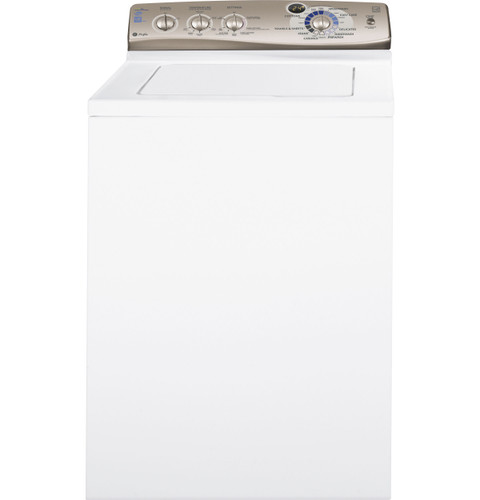
GE Profile PTWN6250M / PTWN6250MWT HydroWave Infusor washer
Find the PTWN6250M washer identity and matching documents
The GE Profile specification sheet is titled PTWN6250M and identifies the white retail model PTWN6250MWT. The owner manual describes this PTWN6250M control and Infusor washer family. For this profile, those are the supported identities; the Energy Guide prints PTWN6250M0WT, so do not silently treat that different string as an exact suffix match.
The model and serial label is under the washer lid. Read it before ordering parts or choosing a document. A receipt title, broad “Profile” name, or similar-looking PTWN model does not establish the same panel or installation details.
- Read model/serial label under lid.
- Use the owner manual for operation and install sheet for hookups/clearances.
- Keep PTWN6250M0WT on Energy Guide distinct from the PTWN6250M/PTWN6250MWT family scope.
Read the lid label carefully
Open the lid and find the model/serial label underneath, as the owner manual directs. Copy every character, including its ending, instead of relying on the name printed on a receipt or control panel. The serial identifies the individual unit; the model identifies its design and documentation.
The specification sheet names PTWN6250M and says Model PTWN6250MWT – White. If the label has another suffix or prefix, keep the label available and locate that exact product’s manual before using cycle, parts or installation instructions.
- Copy the complete model code from the label under the lid.
- Save the serial separately for service.
Choose the document for the question
Use the Use and Care Manual for operation, cycle definitions, temperature, settings, care and owner troubleshooting. Use the separate Installation Instructions for water, drain, electrical grounding, floor, leveling and shipping-bar work. The quick reference explains why HydroWave/Infusor washing may look and sound different from a conventional top-loader.
The energy label is less useful for establishing exact suffix identity: it prints PTWN6250M0WT and estimates use under stated assumptions. Because that code is not literally PTWN6250MWT, this profile does not use it to expand the model scope or promise current household costs.
When the label is hard to read
Use a flashlight and photograph the label without moving or tilting the washer. Wipe only the visible area with a dry cloth. If the label is damaged, provide GE support with the serial, purchase paperwork and a clear control-panel photo; ask them to confirm the model before buying model-specific parts.
Do not infer a model from “Infusor,” “HydroWave” or “Profile” wording alone. Those identify a wash design, not every accessory or option. The owner manual marks some settings and dispenser features “on some models,” so check the actual panel before relying on those instructions.
Keep a reference set with the washer
Store the owner manual and install sheet together. This washer’s operating guide shows its cycle selector, Temperature button, Settings control, estimated-time display and Start/Stop-Pause behavior. Its installation document describes its own hose, drain, leveling and shipping-bar instructions.
For service, provide the label code, serial, selected cycle/settings, display message and whether water remained in the tub. That helps support select the right guide without assuming a motor, valve or pump failed.
This is the white retail model explicitly listed on the PTWN6250M sheet.
Use PTWN6250M family documents and verify exact code before ordering parts.
The shared Profile name does not prove identical controls or parts.
Search the exact code or ask GE support to identify its documents.
The exact family cannot be confirmed by appearance alone.
Have support identify it from serial and purchase details.
Common questions
Where is the model number?
The owner manual places the model and serial label under the washer lid. Record the complete model characters.
Does the Energy Guide code belong to this scope?
Its printed PTWN6250M0WT string differs from PTWN6250MWT, so confirm exact identity rather than treating it as an equivalent suffix.