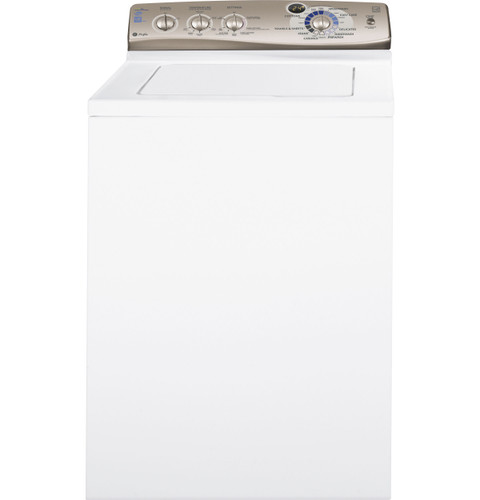
Photo: PTWN6250MWT white variant. Shared source photo. Photo source
Manufacturer sources
GE Profile PTWN6250M
Potential replacement parts
Washing machine · US market · 48 owner topics
GE Profile PTWN6250M
Parts to consider
Potential replacements. Compatibility is not guaranteed. Confirm the complete model, suffix, serial/version, diagram position and current part number with the seller or manufacturer before ordering. Seller links open their listings for current price, stock and returns.
Documented part reference · seller link not reviewed
WH41X10207 — 4 ft rubber water supply hose
Listed as an accessory in the manufacturer-linked owner document, p. 2. Historical identifier, not a stock or price claim; confirm current GE replacement before buying.
This recorded reference does not establish a current replacement or sales offer. Check the full appliance label and current part number with the manufacturer or seller.
Documented part reference · seller link not reviewed
WX14X10005 — 4 ft braided water supply hose
Listed as an accessory in the manufacturer-linked owner document, p. 2. Historical identifier, not a stock or price claim; confirm current GE replacement before buying.
This recorded reference does not establish a current replacement or sales offer. Check the full appliance label and current part number with the manufacturer or seller.
Documented part reference · seller link not reviewed
WH49X301 — Drain hose extension kit
Listed as an accessory in the manufacturer-linked installation document, p. 4. Historical identifier, not a stock or price claim; confirm current GE replacement before buying.
This recorded reference does not establish a current replacement or sales offer. Check the full appliance label and current part number with the manufacturer or seller.
How these suggestions are reviewed · Seller links are unpaid. Specs & Parts does not sell these parts or guarantee fit, performance, or a repair outcome.
The Owner Manual lists two fill hoses and the Installation Instructions list a drain extension. These external items are the only replacements with exact accessory numbers in the owner materials. The full model and serial label is under the lid; use it to check current fitment before ordering.
The manual recommends new fill hoses every five years because hoses degrade. It does not provide a complete internal parts catalog or authorize owners to replace valves, switches, pump, motor or wiring.
Supply hose numbers
WH41X10207 is listed as a four-foot rubber water supply hose; WX14X10005 is listed as a four-foot braided hose. The installation sheet shows two hoses, rubber washers and strainer screens. Confirm that the four-foot length works for the installation and that the exact model accepts the selected hose before purchase.
For a longer drain run, the installation sheet specifically names GE WH49X301 and directs the installer to connect the kit’s extra hose to the original with the kit clamp. The rear hose also uses a retaining clamp and screws. Do not choose a generic extension by appearance or omit the restraint.
Replace a hose with visible cracking, bulging, corrosion or leakage; do not wait for a burst. Turn off the household faucets before disconnecting. The installation sheet shows rubber washers at hose ends, hot to H and cold to C, and requires a leak check after reconnecting. If valves cannot be shut off or threads are damaged, stop and use an installer.
The troubleshooting chart lists symptoms such as no fill, no drain and lid detection, but does not identify internal part numbers or replacement procedures. A no-fill symptom can involve supply valves, screens or setup; a no-spin symptom can reflect cycle choice, balance, lid or retained water. Have a technician diagnose before ordering a valve, pump, motor or control.
Provide the full model/serial and distinguish hot/cold supply from drain extension. The product record marks the unit obsolete, so listings may be incomplete; confirm availability, return policy and fitment with GE or an authorized seller. A similar GE Profile prefix or matching appearance is not sufficient evidence.
The serial/model label is beneath the washer lid. Give parts support the full code and explain whether you need a hot/cold supply hose, drain extension or an internal repair estimate. A supply hose connects the household valve to rear H/C fittings; the drain extension joins the washer’s drain hose to the home drain route. They are not interchangeable.
The installation diagram shows rubber washers and strainer screens at supply hose connections, plus a rear clamp and screws for retaining the drain hose. For a leaking connection, replacing only the hose without its washer or proper restraint may repeat the problem. Ask the seller to confirm the exact product code and included fittings before purchase.
GE Profile PTWN6250M is associated with GE Appliances, a Haier company in the original regulatory record. Use both the retail brand and this company name when researching an older manual, parts listing, or recall notice. This historical listing identifies the source relationship; the complete model and serial still determine a replacement part or service arrangement.
These historical identifiers are separate from the reviewed suggestions above. Their original records have not been renewed for current shopping. Recheck any supersession or fit restrictions with the manufacturer.
Source-listed part or accessory
WH41X10207
4 ft rubber water supply hose
Listed as an accessory in the manufacturer-linked owner document, p. 2. Historical identifier, not a stock or price claim; confirm current GE replacement before buying.
Listed as an accessory in the manufacturer-linked installation document, p. 4. Historical identifier, not a stock or price claim; confirm current GE replacement before buying.
Listed as an accessory in the manufacturer-linked owner document, p. 2. Historical identifier, not a stock or price claim; confirm current GE replacement before buying.
Exact-model manufacturer resource; Specification 260192, revised 4/11, pp. 1–2; explicit base and finish listing
GE specification 260192, revised 4/11, titles the base PTWN6250M and explicitly lists finish model PTWN6250MWT. Base/retail relationship is documented here; no other suffix or serial range is inferred. Specification 260192, revised 4/11, pp. 1–2; explicit base and finish listing
Observed Oct 27, 2026
Other observations retained:
3.7 cu ft — California Energy Commission — Washing machines archive; cec-washers.xlsx; sheet ClothesWashers_12022025; row 4128
GE specification 260192, revised 4/11, titles the base PTWN6250M and explicitly lists finish model PTWN6250MWT. Base/retail relationship is documented here; no other suffix or serial range is inferred. Owner manual 49-90400-1, 07/06/10; pp. 1, 4–7, 9
GE specification 260192, revised 4/11, titles the base PTWN6250M and explicitly lists finish model PTWN6250MWT. Base/retail relationship is documented here; no other suffix or serial range is inferred. Owner manual 49-90400-1, 07/06/10; pp. 1, 4–7, 9
Exact-model manufacturer resource; Specification 260192, revised 4/11, pp. 1–2; explicit base and finish listing
GE specification 260192, revised 4/11, titles the base PTWN6250M and explicitly lists finish model PTWN6250MWT. Base/retail relationship is documented here; no other suffix or serial range is inferred. Specification 260192, revised 4/11, pp. 1–2; explicit base and finish listing
Observed Oct 27, 2026
Wash programs
Cottons, Prewash, Casuals, Easy Care, Delicates, Hand Wash, Speed, Drain & Spin, Towels & Sheets, Jeans, Quick Rinse
GE specification 260192, revised 4/11, titles the base PTWN6250M and explicitly lists finish model PTWN6250MWT. Base/retail relationship is documented here; no other suffix or serial range is inferred. Owner manual 49-90400-1, 07/06/10; pp. 1, 4–7, 9
Exact-model manufacturer resource; Specification 260192, revised 4/11, pp. 1–2; explicit base and finish listing
GE specification 260192, revised 4/11, titles the base PTWN6250M and explicitly lists finish model PTWN6250MWT. Base/retail relationship is documented here; no other suffix or serial range is inferred. Specification 260192, revised 4/11, pp. 1–2; explicit base and finish listing
Observed Oct 27, 2026
More background: Parts & components
Category & symptom guidance
Parts & components
4 minute read · Shared guidance for washing machines
Start with what the washer is doing
Describe the failure in observable terms: water appears at a hose connection, the drum will not drain, a control does not respond, or the load comes out unusually wet. Note when it happens in the cycle and whether it repeats with an empty washer. These details help distinguish a part problem from a setup issue. A wet floor near the rear, for example, points first toward inlet or drain connections; water left in the drum after a cycle suggests documenting the drain behavior before naming a pump.
Separate the part you can see from the part that may have failed. A cracked hose is directly visible. A washer that stops filling may involve a household supply, kinked hose, screen, valve, or control, and the symptom alone does not identify which one. Avoid buying an internal component based only on a noise, code, or online discussion.
Identify the washer and the component
Find the complete model designation on the product label and distinguish it from a family name or a shortened listing title. Record the suffix and any revision characters exactly. Parts catalogs can split models that look nearly identical by production range, market, finish, or design revision; a partial match is not enough to establish fit.
Use a parts diagram or catalog to locate the component by its position and description. Confirm whether the listing identifies a single part, an assembly, a kit, or a left/right variant. Compare the illustration with the physical area only to orient yourself; an exploded diagram is not a repair procedure and may omit clips, seals, or one-time fasteners.
Sort owner items from internal parts
Installation items such as inlet hoses and drain-hose restraints are different from internal operating components. The GE PTWN6250M installation sheet lists two water hoses, rubber washers, strainer screens, a drain hose, an antisiphon clip, and a cable tie as installation materials. The GE owner manual also lists two hose choices for that named washer. Those lists illustrate the kinds of items that may be needed; they do not establish that a hose or accessory fits another GE model or a different washer design.
For routine owner care, use only the cleaning or maintenance steps stated for the exact washer. The LG WM4000H*A manual identifies its drain pump filter and filter cover as visible product components, but that does not mean every front-load or top-load washer has the same access arrangement. Do not remove a panel to reach a part unless the owner instructions specifically describe that task.
Check the listing before checkout
Ask the seller to confirm applicability using the entire model number, not a broad description such as “fits top-load washers.” Compare the part number and, if available, superseded-number history against the manufacturer’s catalog. A listing that says “replaces” should identify the earlier number and the models it covers; treat an unexplained number change as unresolved.
Check what is included. A drain or inlet kit may contain seals or clamps that are not included with a bare component. Confirm whether the old part is returnable, whether the listing is for a new or refurbished item, and whether the seller’s photograph is representative. Keep the order confirmation and packaging until fit and condition are established.
Match the full model designation to the catalog entry.
Confirm the part number, included pieces, and any stated supersession.
Pause the order if the seller cannot verify the model or the listing conflicts with the catalog.
Know when part identification becomes repair work
A component name in a catalog does not mean it is an owner-replaceable part. GE’s PTWN6250M owner manual says not to attempt replacement unless the manual or published user-repair instructions specifically recommend it and the owner understands the procedure and has the skills. LG’s WM4000H*A manual directs repairs to qualified service personnel except where the manual specifically recommends otherwise. Treat internal wiring, motor, control-board, valve, and pump work as service unless exact instructions expressly make a task owner maintenance.
If the evidence points to a visible external hose or installation piece, first compare the washer’s installation sheet and inspect for obvious damage without disassembling the appliance. If the leak or fault appears to originate inside the cabinet, preserve the symptom details and arrange diagnosis rather than guessing at a component.
What to do with what you find
The model suffix is missing or the seller confirms only a broad washer family.
Fit has not been established.
Get a catalog match for the full designation before ordering.
The suspected part is inside the cabinet or involves wiring, a valve, motor, pump, or control board.
The symptom does not confirm a safe owner repair.
Use the owner manual’s repair boundary and request diagnosis.
Have these details ready
Full model designation and label location.
Symptom, cycle stage, and visible leak or damage location.
Catalog entry and part number, including kit contents or supersession details.
Common questions
Does a similar-looking part guarantee it fits?
No. Verify the exact model and part number in a manufacturer catalog or have the seller confirm both.
Can a parts diagram tell me how to install a component?
Usually it identifies location and part relationships; use a model-specific repair procedure for installation, if one is published for owners.
General background sources
These sources support the shared guide. Exact model specifications and matched family procedures have their own sources above.