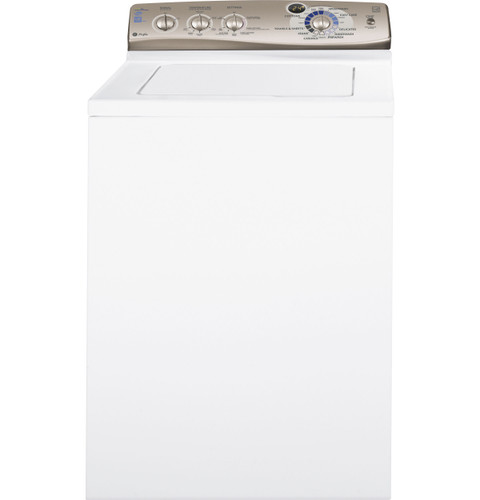
Photo: PTWN6250MWT white variant. Shared source photo. Photo source
Manufacturer sources
GE Profile PTWN6250M
Component replacement planning
Washing machine · US market · 48 owner topics
GE Profile PTWN6250M
Parts to consider
Potential replacements. Compatibility is not guaranteed. Confirm the complete model, suffix, serial/version, diagram position and current part number with the seller or manufacturer before ordering. Seller links open their listings for current price, stock and returns.
Documented part reference · seller link not reviewed
WH41X10207 — 4 ft rubber water supply hose
Listed as an accessory in the manufacturer-linked owner document, p. 2. Historical identifier, not a stock or price claim; confirm current GE replacement before buying.
This recorded reference does not establish a current replacement or sales offer. Check the full appliance label and current part number with the manufacturer or seller.
Documented part reference · seller link not reviewed
WX14X10005 — 4 ft braided water supply hose
Listed as an accessory in the manufacturer-linked owner document, p. 2. Historical identifier, not a stock or price claim; confirm current GE replacement before buying.
This recorded reference does not establish a current replacement or sales offer. Check the full appliance label and current part number with the manufacturer or seller.
Documented part reference · seller link not reviewed
WH49X301 — Drain hose extension kit
Listed as an accessory in the manufacturer-linked installation document, p. 4. Historical identifier, not a stock or price claim; confirm current GE replacement before buying.
This recorded reference does not establish a current replacement or sales offer. Check the full appliance label and current part number with the manufacturer or seller.
How these suggestions are reviewed · Seller links are unpaid. Specs & Parts does not sell these parts or guarantee fit, performance, or a repair outcome.
PTWN6250M / PTWN6250MWT: separate owner care from component repair
3 minute read · Sources linked below
For this washer, replacement guidance in the owner materials centers on external fill hoses and the drain extension kit. The manual warns against repairing or replacing parts unless recommended in the Owner Manual or understood published user-repair instructions. Internal service should not be inferred from a symptom.
Water connections and a grounded electrical supply make cabinet work inappropriate as a trial-and-error task.
Replace fill hoses on schedule or when damaged
GE recommends changing fill hoses every five years. It lists WH41X10207 rubber and WX14X10005 braided four-foot hoses. Inspect the visible length for bulges, cracks, rust or leakage. Shut off both faucets before disconnecting; reinstall washers and check for drips. If a valve does not shut off, call a plumber.
The hose is secured at the rear with a clamp and two screws. If a longer drain connection is required, the installation sheet names WH49X301 and its supplied clamp. Check for a kink or crushed area before considering replacement. Maintain the open standpipe and the specified height range; incorrect routing can cause drainage problems even with a new hose.
For stopped inlet screens, GE instructs owners to turn off the water source, remove the hoses at the upper rear, clean screens with a brush or toothpick, reconnect and turn water back on. This is not a valve replacement. If the screen is damaged, fitting is seized, or water keeps flowing with the faucet closed, do not proceed.
The owner troubleshooting chart does not give replacement procedures for the inlet valve, drain pump, shifter, motor, control or lid magnet. It explicitly directs service for a missing lid magnet. Symptoms overlap: wet laundry can be a slow-spin cycle, imbalance or drain restriction. Get a qualified diagnosis and match parts to complete model and serial before purchase.
If there is a leak, stop use and close accessible faucets from a dry location. Do not tip the machine, remove panels, test live wiring or bypass the lid safety feature. A repeatedly tripping breaker, damaged cord or water near an outlet is a stop-use condition for qualified service.
Understand the distinction between cleaning and replacement
The inlet-screen procedure is owner cleaning: turn off water, remove inlet hoses, clean the screens, reconnect and restore the supply. It does not mean the inlet valve should be replaced. Similarly, a loose visible drain hose can be reseated using the installation instructions, but a pump failure is not covered by a user repair procedure in this manual.
The product data says front serviceable, but that is a product feature, not authorization for an owner to open the cabinet. Electrical, lid-detection and moving components still require proper service. Ask the technician which observed test established the failed part and verify the replacement against PTWN6250M/PTWN6250MWT rather than accepting a generic family match.
Use care instructions for the dispenser components
The fabric softener dispenser is described as self-cleaning and not requiring regular cleaning. The manual’s bleach funnel is designed to dilute liquid chlorine bleach during fill; it warns not to pour undiluted bleach directly onto clothes or powdered bleach into the funnel. A dispenser complaint therefore begins with correct use and the relevant option, not replacement of a dispenser assembly.
GE Profile PTWN6250M is associated with GE Appliances, a Haier company in the original regulatory record. Use both the retail brand and this company name when researching an older manual, parts listing, or recall notice. This historical listing identifies the source relationship; the complete model and serial still determine a replacement part or service arrangement.
These historical identifiers are separate from the reviewed suggestions above. Their original records have not been renewed for current shopping. Recheck any supersession or fit restrictions with the manufacturer.
Source-listed part or accessory
WH41X10207
4 ft rubber water supply hose
Listed as an accessory in the manufacturer-linked owner document, p. 2. Historical identifier, not a stock or price claim; confirm current GE replacement before buying.
Listed as an accessory in the manufacturer-linked installation document, p. 4. Historical identifier, not a stock or price claim; confirm current GE replacement before buying.
Listed as an accessory in the manufacturer-linked owner document, p. 2. Historical identifier, not a stock or price claim; confirm current GE replacement before buying.
Exact-model manufacturer resource; Specification 260192, revised 4/11, pp. 1–2; explicit base and finish listing
GE specification 260192, revised 4/11, titles the base PTWN6250M and explicitly lists finish model PTWN6250MWT. Base/retail relationship is documented here; no other suffix or serial range is inferred. Specification 260192, revised 4/11, pp. 1–2; explicit base and finish listing
Observed Oct 27, 2026
Other observations retained:
3.7 cu ft — California Energy Commission — Washing machines archive; cec-washers.xlsx; sheet ClothesWashers_12022025; row 4128
GE specification 260192, revised 4/11, titles the base PTWN6250M and explicitly lists finish model PTWN6250MWT. Base/retail relationship is documented here; no other suffix or serial range is inferred. Owner manual 49-90400-1, 07/06/10; pp. 1, 4–7, 9
GE specification 260192, revised 4/11, titles the base PTWN6250M and explicitly lists finish model PTWN6250MWT. Base/retail relationship is documented here; no other suffix or serial range is inferred. Owner manual 49-90400-1, 07/06/10; pp. 1, 4–7, 9
Exact-model manufacturer resource; Specification 260192, revised 4/11, pp. 1–2; explicit base and finish listing
GE specification 260192, revised 4/11, titles the base PTWN6250M and explicitly lists finish model PTWN6250MWT. Base/retail relationship is documented here; no other suffix or serial range is inferred. Specification 260192, revised 4/11, pp. 1–2; explicit base and finish listing
Observed Oct 27, 2026
Wash programs
Cottons, Prewash, Casuals, Easy Care, Delicates, Hand Wash, Speed, Drain & Spin, Towels & Sheets, Jeans, Quick Rinse
GE specification 260192, revised 4/11, titles the base PTWN6250M and explicitly lists finish model PTWN6250MWT. Base/retail relationship is documented here; no other suffix or serial range is inferred. Owner manual 49-90400-1, 07/06/10; pp. 1, 4–7, 9
Exact-model manufacturer resource; Specification 260192, revised 4/11, pp. 1–2; explicit base and finish listing
GE specification 260192, revised 4/11, titles the base PTWN6250M and explicitly lists finish model PTWN6250MWT. Base/retail relationship is documented here; no other suffix or serial range is inferred. Specification 260192, revised 4/11, pp. 1–2; explicit base and finish listing
Observed Oct 27, 2026
More background: Component replacement planning
Category & symptom guidance
Component replacement planning
4 minute read · Shared guidance for washing machines
Turn the symptom into a repair question
Before discussing replacement, write down the exact behavior: what the washer did, which cycle stage, whether water remained, whether a leak was visible, and what changed immediately before the problem began. Note whether the issue happens every load or only with a particular load type. A load that finishes wet can arise from an interrupted cycle, an unbalanced load, a drain problem, or a component fault; it is not proof that a motor or control needs replacement.
Keep operating observations distinct from conclusions. “The washer stopped during rinse with water in the tub” is useful. “The drain pump failed” is a proposed diagnosis. Ask the service provider to explain what observation or test supports the diagnosis and whether another cause remains plausible.
Get a defined diagnosis and scope
Request the proposed repair in writing before authorizing work. It should name the suspected component, the evidence supporting replacement, whether diagnosis is included, and what happens if the first part does not correct the symptom. Ask whether the quote includes labor, travel or dispatch charges, taxes, parts, and a return visit if the replacement does not resolve the reported problem. This turns a one-line estimate into a scope you can compare.
Ask whether the technician will inspect related connections or conditions that could create the same symptom. For a drain complaint, clarify whether the diagnosis includes checking the drain path and the washer’s installation conditions. For a filling complaint, ask whether incoming supply and hose restrictions are considered before a valve is proposed. These questions do not prescribe internal testing; they establish what the billed visit will cover.
Check whether the part is model-specific
Have the provider verify the full model designation and any serial or production information requested by the manufacturer. Ask for the proposed part number and whether the quote covers a component alone or a larger assembly. A supplier’s broad fit statement is not enough when variants differ; the manufacturer catalog or the service provider should connect the quoted number to the exact washer.
Ask whether a part is being substituted or superseded and what documentation supports that choice. Do not assume that a visually similar component, a listing for the same brand, or an online repair discussion establishes fit. For a part with no confirmed application, pause authorization until the provider resolves the mismatch.
Compare replacement with the alternatives
Compare the repair total with the price of the outcome you need: a functioning washer with the reported problem corrected. Request a second quote when the diagnosis is uncertain, the proposed repair is a major assembly, or the scope is hard to understand. Compare the same items across estimates, including diagnostic fee, parts, labor, taxes, visit charges, and warranty on the work. Do not compare a parts-only internet price with an installed-service quote as if they cover the same job.
Ask what choices exist if the repair is declined, including whether the diagnostic charge still applies. A replacement washer comparison should use your own delivered and installed quote, removal or disposal charges, and any changes needed at the laundry connection. There is no reliable universal repair-cost threshold without those owner-specific numbers.
Write down the all-in repair estimate and what it includes.
Obtain a comparable installed replacement quote if replacement is being considered.
Decide using the difference between the owner-specific totals and the expected usefulness of the repair.
Clarify parts, labor, and repeat-visit coverage
Ask how long the provider stands behind the installed part and labor, what proof of service is supplied, and whether coverage changes if a different failure appears later. A part warranty and a service provider’s workmanship promise can be separate. Get the terms in writing rather than relying on a verbal description.
If the washer may still be under a written manufacturer warranty, check the actual warranty document for the model and the claim process before paying for a repair. Warranty language determines coverage; a specification sheet or product advertisement does not. The FTC explains that written warranties have terms and limitations, so ask the warrantor whether the proposed work must be authorized or performed through its process before proceeding.
What to do with what you find
The quote names a component but does not explain what supports the diagnosis.
Replacement remains a hypothesis.
Ask what symptom or diagnostic finding identifies that component and what alternatives were considered.
The proposed part is not tied to the complete model designation.
Fit and repair scope are unresolved.
Request the exact part number and model application before authorization.
Have these details ready
Full model designation and serial or production detail if requested.
Observed symptom, cycle stage, and repeatability.
Written diagnosis, part number, labor, fees, tax, and coverage terms.
Comparable delivered and installed replacement quote when relevant.
Common questions
Should I authorize replacement based on a symptom alone?
Ask for the diagnosis evidence and the written scope first; one symptom can have several causes.
How should I decide between repair and a new washer?
Compare owner-specific all-in quotes for equivalent outcomes, including diagnosis, installation, and removal or disposal.
General background sources
These sources support the shared guide. Exact model specifications and matched family procedures have their own sources above.