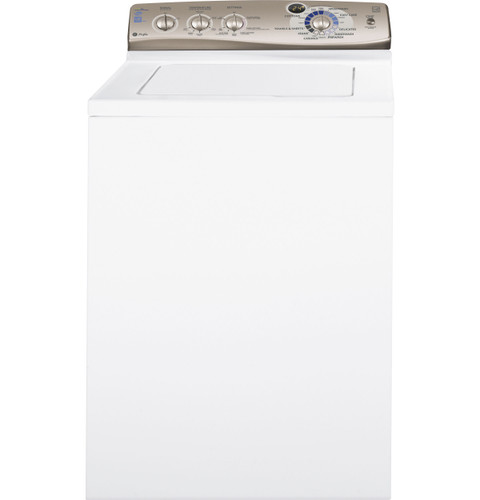
GE Profile PTWN6250M / PTWN6250MWT HydroWave Infusor washer
Specification-based review of the GE Profile PTWN6250M
This is an assessment of published specifications and owner guidance, not a hands-on test or owner-rating summary.
What its published design does well
This is a specification-based assessment, not a hands-on test or a summary of owner ratings. GE documents a 3.6 DOE-cubic-foot top-loader with HydroWave HE LoWater washing, an Infusor, and PreciseFill. The core tradeoff is clear: it is designed to use concentrated low-water washing and automatic fill measurement rather than showing a high water line familiar from older deep-fill machines. GE’s quick reference explicitly says water may not cover the top of clothes and that this is normal.
The spec sheet lists 700 RPM spin, Speed Wash for lightly soiled items, specialty cycles, and MEF/WF values. A higher spin can leave less moisture for a dryer, and the advertised short cycle can suit a lightly soiled urgent load. These are feature claims from GE’s documents, not independently measured performance results.
What an owner should consider
A buyer who expects visible deep water may find the low-water system unfamiliar. GE specifies HE detergent and advises reducing detergent for small or lightly soiled loads or soft water; overdosing can undermine results. Load arrangement matters: distribute items loosely around the Infusor and avoid covering it with a heap. The design’s proper use may require changing habits from a conventional agitator washer.
The documented capacity is 3.6 DOE cubic feet, so compare it with the amount and type of laundry in your household. A bulky blanket may need different loading or a larger laundromat machine. The spec sheet’s 42 × 27 × 25.5-inch nominal dimensions also make doorway, hose, lid, and service clearance relevant before purchasing or moving one.
What the documents do not prove
The published specification does not establish reliability, noise level in a particular home, cleaning performance on every stain, service availability today, or how much a specific household will save. “Quiet-By-Design” is GE’s product wording, not a measured decibel result. The EnergyGuide’s annual cost estimate is based on eight weekly loads and 2007 national-average utility rates; it should not be read as a modern cost forecast.
Warranty language needs careful reading. The 2011 spec advertises lifetime stainless-tub and limited ten-year parts coverage, while the owner manual names the basket as lifetime coverage and specified assemblies for years 2–10, with labor paid by the owner for those later periods. A potential buyer should review the written terms rather than relying on a broad marketing summary.
A fair conclusion
The documents show a capable-for-its-era, high-efficiency top-loader with useful fill sensing, a moderate documented capacity, a 700-RPM spin, and dedicated cycles. Its strengths matter most to an owner who accepts HE detergent, low-water operation, and correct load placement. Its tradeoffs are uncertainty about an individual machine’s history, an obsolete product listing, and no basis here for a reliability ranking or current repair-parts guarantee.
For a used unit, inspect condition, test fill/agitation/drain/spin, check for leaks and rust, and obtain a service estimate if symptoms appear. Those are evaluation steps, not evidence of an independent review. Compare its documented dimensions, capacity, spin, and written warranty with the actual replacement candidates before deciding.