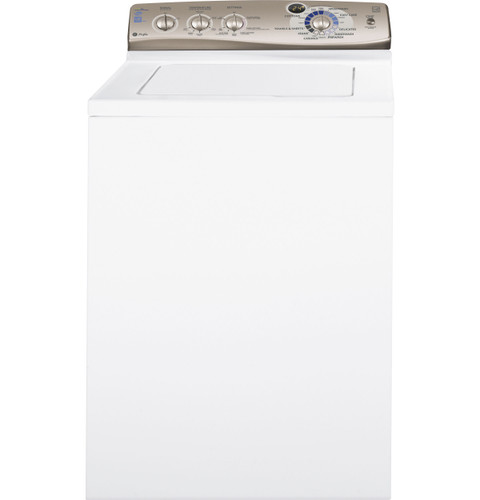
Potential replacements. Compatibility is not guaranteed. Confirm the complete model, suffix, serial/version, diagram position and current part number with the seller or manufacturer before ordering. Seller links open their listings for current price, stock and returns.
Documented part reference · seller link not reviewed
WH41X10207 — 4 ft rubber water supply hose
Listed as an accessory in the manufacturer-linked owner document, p. 2. Historical identifier, not a stock or price claim; confirm current GE replacement before buying.
This recorded reference does not establish a current replacement or sales offer. Check the full appliance label and current part number with the manufacturer or seller.
Documented part reference · seller link not reviewed
WX14X10005 — 4 ft braided water supply hose
Listed as an accessory in the manufacturer-linked owner document, p. 2. Historical identifier, not a stock or price claim; confirm current GE replacement before buying.
This recorded reference does not establish a current replacement or sales offer. Check the full appliance label and current part number with the manufacturer or seller.
Documented part reference · seller link not reviewed
WH49X301 — Drain hose extension kit
Listed as an accessory in the manufacturer-linked installation document, p. 4. Historical identifier, not a stock or price claim; confirm current GE replacement before buying.
This recorded reference does not establish a current replacement or sales offer. Check the full appliance label and current part number with the manufacturer or seller.
How these suggestions are reviewed · Seller links are unpaid. Specs & Parts does not sell these parts or guarantee fit, performance, or a repair outcome.
Use the complete model identity and the washer’s actual dispenser configuration when sourcing replacement consumables or parts.
Replace water hoses on a schedule
GE’s PTWN6250M owner manual says to change water-supply hoses every five years because hoses degrade over time. It identifies WH41X10207 (4-foot rubber) and WX14X10005 (4-foot braided) as available examples. Use your existing reach and faucet layout to confirm length, then verify the selected hose against the current parts listing for the complete model PTWN6250MWT. Don’t assume that a hose that threads on is appropriate: the washer needs the correct hot/cold connections and intact sealing washers.
Before removal, close both water faucets and unplug the washer. Place a towel and shallow pan under connections because water remains in hoses. Follow the installation sheet for tightening and leak-checking; after reconnection, open each valve slowly and inspect both faucet and washer ends. If a connection leaks after careful installation, shut off the faucet rather than tightening against a running leak.
GE’s manual qualifies its fabric-softener dispenser instructions with “on some models.” Check whether your washer has the removable dispenser cup and the FABRIC SOFTENER setting before ordering a replacement. The quick-reference sheet explains that the cup sits in the Infusor: lift its lid, measure softener into it, close the lid, then choose FABRIC SOFTENER. A dispenser cup cannot be presumed from the family name alone. The control-panel label and parts diagram for the complete suffix determine what is fitted.
If the cup is present but drains poorly, inspect the cup’s small passage and the Infusor’s drain holes before replacing it. The manual gives a cleaning method using warm water, liquid detergent, and bleach; do not scrape plastic passages with a sharp tool. Reinstall the pieces in their original orientation and check that the tab engages. A broken tab or cracked cup is a stronger replacement signal than ordinary softener film.
Detergent, bleach, and softener are consumables chosen by the owner; fill hoses and a dispenser are parts with model and fit questions. Keep those categories distinct when shopping. The washer is a 120-volt, 10-amp appliance with a grounded three-prong connection, but that electrical rating does not identify a washer repair component. For a control, suspension, drain, or basket part, record the full model and serial from the appliance label and use GE’s parts lookup or an authorized technician.
The written warranty assigns different time periods to specific components, and later coverage generally leaves labor to the owner. Before buying a part, compare the failure description with the actual warranty wording and ask GE to confirm whether the serial and purchase date qualify. A generic listing for “PTWN6250” may omit the suffix needed to distinguish a compatible part.
After hose replacement, run a fill and drain cycle while watching the faucet joints, rear connections, and drain routing. The installation guide says the drain hose must be secured and installed within its specified standpipe or tub height; a kink or poorly positioned drain hose can cause trouble that resembles a washer fault. Check the exact installation sheet rather than using a replacement hose to compensate for a plumbing arrangement outside its limits.
After replacing a dispenser, run a small load with the specified option and inspect the clothes for concentrated softener marks. If the option or dispenser does not match the control, stop and verify the washer’s exact model configuration. Don’t infer fit or wiring from a part seller’s cross-reference alone.
GE Profile PTWN6250MWT is listed as Top-Loading high-efficiency. For this recorded top-loading GE Profile design, place the first inspection at the lid, basket rim, fitted dispenser and the visible fill/drain connections. For a spin complaint, separate retained water from an uneven load, then check the selected cycle and lid state. Keep clothing loose enough to move; an agitator, impeller or automatic-fill procedure needs its own feature match.
These historical identifiers are separate from the reviewed suggestions above. Their original records have not been renewed for current shopping. Recheck any supersession or fit restrictions with the manufacturer.
Source-listed part or accessory
WH41X10207
4 ft rubber water supply hose
Listed as an accessory in the manufacturer-linked owner document, p. 2. Historical identifier, not a stock or price claim; confirm current GE replacement before buying.
Listed as an accessory in the manufacturer-linked installation document, p. 4. Historical identifier, not a stock or price claim; confirm current GE replacement before buying.
Listed as an accessory in the manufacturer-linked owner document, p. 2. Historical identifier, not a stock or price claim; confirm current GE replacement before buying.
Exact-model manufacturer resource; Specification 260192, revised 4/11, pp. 1–2; explicit base and finish listing
GE specification 260192, revised 4/11, titles the base PTWN6250M and explicitly lists finish model PTWN6250MWT. Base/retail relationship is documented here; no other suffix or serial range is inferred. Specification 260192, revised 4/11, pp. 1–2; explicit base and finish listing
GE specification 260192, revised 4/11, titles the base PTWN6250M and explicitly lists finish model PTWN6250MWT. Base/retail relationship is documented here; no other suffix or serial range is inferred. Owner manual 49-90400-1, 07/06/10; pp. 1, 4–7, 9
3 minute read · Shared guidance for washing machines
Decide whether replacement is due
Inspect exposed supply hoses for cracks, bulges, kinks, abrasion, dampness, or rust staining around the fittings. A damaged hose should be addressed promptly; do not wait for a scheduled interval. If there is no visible damage, use the replacement guidance in the washer’s manual rather than assuming every hose has the same service life.
Intervals differ by product guidance. GE’s PTWN6250M owner manual recommends changing hoses every five years, and the LG WM4000H*A manual also says to replace hoses every five years. These are examples tied to those models. They do not establish an interval for all washers. If the washer manual is missing, identify the model from its rating label and obtain the correct installation or owner document before deciding.
Plan the hose change around fit and water control
Before buying, confirm the washer’s hot and cold connections, household faucet connections, and the required reach with the machine in its final position. Select new hoses that meet the appliance instructions and applicable local requirements. Do not stretch hoses taut, route them where the washer can crush them, or let them kink behind the cabinet.
If you cannot close both water supply valves, the valves are seized, or the washer is in a position that makes a leak difficult to contain, arrange help before disconnecting anything. A hose change involves household water connections, so prepare towels and a container and keep the work area clear. Never attempt to substitute a shutoff or alter plumbing as part of this appliance task.
Follow the exact installation sequence
Use the installation instructions for the washer, not a video for a similar-looking machine. They should identify the hot and cold ports, whether hose seals are supplied, the permitted tightening approach, and what to check after opening the household valves. Do not cross-thread fittings or overtighten them; either can damage a connection and cause a leak.
After installation, inspect the hose connections at both ends while the valves are open. If any connection drips, close the valves and correct the issue only as the manufacturer’s instructions permit. Do not run a load to test a visibly wet connection. The GE PTWN6250M installation sheet, for example, gives model-specific hose connection details; use those only if that is the exact washer.
Replace filters only when owner instructions say to
Some front-load washers provide an accessible drain-pump filter that owners clean periodically; a top-load model may have a different lint or inlet-screen arrangement. Replacement is not automatically required just because a filter exists. First determine whether the manual calls for cleaning or a new part, and whether the item is accessible without removing the cabinet.
If the manual does describe owner access, follow its drainage and reassembly directions exactly. Water may remain behind a pump-filter cover, so do not open it if you cannot catch and contain the discharge. For a missing cap, damaged threads, persistent leakage, or a part that will not seat as described, stop. Do not improvise a plug or run the washer with an uncertain seal.
What to do with what you find
Hose has visible damage or is actively leaking.
The connection may fail or cause water damage; a calendar interval is not the deciding factor.
Close accessible water valves and arrange hose replacement or plumbing assistance before washing.
A filter part is not explicitly identified as owner-serviceable.
Removing it may expose water or internal components beyond routine maintenance.
Confirm the model-specific instructions or ask manufacturer support to identify the correct procedure.
Have these details ready
Full washer model and its installation or maintenance instructions.
Visible hose condition and whether both household shutoffs operate.
Filter location, manual direction, and any proposed replacement part number.
Common questions
Can I reuse a hose that looks fine?
Follow the washer’s installation guidance. GE’s PTWN6250M and LG’s WM4000H*A installation documents recommend new hoses for their respective models; do not generalize that named guidance without checking your product instructions.
Should I replace a pump filter on a schedule?
Not unless the exact washer’s manual says it is a replaceable scheduled item. Many owner-accessible filters are meant to be cleaned, and other designs differ.
General background sources
These sources support the shared guide. Exact model specifications and matched family procedures have their own sources above.