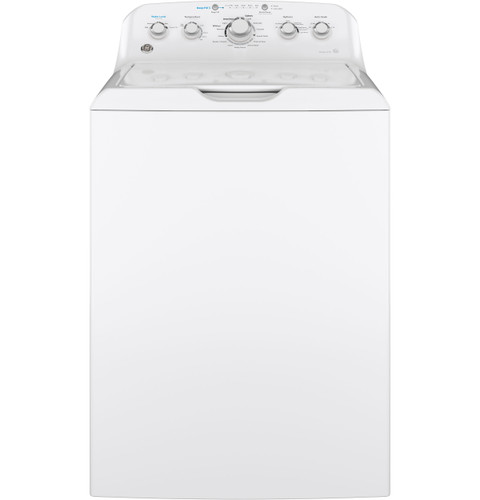
GE GTW465ASNWW agitator top-load washer
GTW465: follow fill, agitation, drain, and spin as four separate stages
The GTW465ASNWW is a top-load washer with an agitator, stainless basket, and owner-selectable water and rinse choices. When a cycle stops or clothes stay wet, identify which stage did not happen: fill, agitation, drain, or spin. One symptom alone rarely identifies a failed component.
The flashing Fill light has a documented behavior on newer GE top-load designs: the controls can remain locked for a four-minute interval while the machine waits for water. The pump lockout must expire on its own; unplugging restarts it. Confirm the panel message and model manual before applying that rule to another washer.
If Fill flashes, let the lockout finish
For GTW465ASNWW, the owner manual specifies a four-minute lockout when H2O SUPPLY scrolls or the Fill indicator signals water is not entering. The controls will not respond during the interval, and unplugging restarts the full four minutes. Open both hot and cold faucets, wait without disconnecting power, then press Start again.
If H2O SUPPLY returns, the manual says to check that supply hoses connect hot-to-H and cold-to-C, the faucets are open, and the hoses are not kinked. It also lists clogged inlet screens as a possible fill cause; follow the manual’s unplugged, valve-closed cleaning procedure for screens rather than opening the control cabinet.
Load the agitator basket so items can move around the center post
Place garments loosely around the agitator rather than wrapping them tightly around it or packing the basket to the rim. Mix large and small pieces so the load distributes through agitation and spin. An overloaded basket can prevent rollover and leave detergent or soil on clothing; a single heavy item can become lopsided at spin. If the washer pauses or thumps, wait for the correction attempt and redistribute laundry before assuming the drive is damaged.
Check the GTW465 cycle guide for the fabric and soil level, then use the chosen water level and options deliberately. Deep Fill changes the amount of water available on models offering it; it does not replace correct load size. A full basket is not automatically an efficient load if clothing cannot circulate.
Distinguish an intentionally low water level from no fill
High-efficiency top-loaders may use less visible water than older deep-water designs. Compare the actual behavior with the selected load-size or fill option and the owner manual, rather than expecting water to cover the clothes. If the fill sound begins, water enters, and the basket starts, the cycle may be operating as designed even when the load is not submerged.
A true fill complaint looks different: the cycle does not reach agitation, the Fill indicator continues, or water never enters despite open supply valves. GE’s support article recommends checking household supply and waiting through the lockout. If a hose screen is suspected, maintenance should follow the unplugged, closed-valve instructions in the manual; do not remove an energized inlet assembly.
A load that is wet after spin can be load-related
The GTW465 manual says blinking Spin/Rinse lights can mean the washer is trying to rebalance; after a failed full-speed spin, redistribute the load and run Drain & Spin. For waterproof or bulky items, it instructs owners to use Bulky (or Delicates) and not mix waterproof with non-waterproof items, because other cycles can cause excessive vibration.
If water remains in the basket, select Drain & Spin rather than adding water. A load that is damp with an empty tub has a different clue: the manual says the machine may reduce spin speed when it cannot balance the load. Check leveling feet only with the machine stopped.
Record what the washer did before resetting
Note selected cycle, water level choice, indicator lights, whether the lid locked, and whether the agitator moved. A timer pause during sensing or load correction may be normal; an unchanged flashing Fill indicator is a different observation. Photograph the panel before cancelling so an unusual state is preserved.
A single controlled retry is reasonable only after the manual-directed wait and supply check. Avoid repeated unplugging, changing water options, and restarting while the machine still contains water. If the same stage fails again, stop and provide the sequence to GE service.
Keep owner checks outside the cabinet
Owners can check controls, household valves, visible hose routing, load arrangement, and the level/stability of the washer. Do not remove the backsplash, access electrical parts, bypass the lid lock, or reach under a running washer. Water and moving parts make a seemingly simple test unsafe.
Arrange service if the washer trips household power, leaks from below, repeatedly fails to agitate or spin with a balanced load, or makes a grinding sound that follows the basket rather than the load. Include the exact GTW465 suffix, Fill light behavior, cycle stage, and whether water remained in the tub.