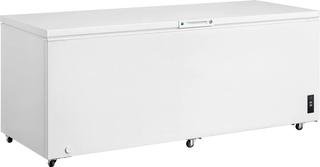
Frigidaire’s cataloged chest-freezer group is manual-defrost; the supported owner guidance treats temperature setting, alarm, lid seal, ambient conditions and loading as first checks. Specific alarms and control layouts vary by model.
Total capacity
24.8 cu ft
Refrigerator configuration
Chest Freezer
Annual energy use
426 kWh/year
Reported width
84 in
2 detailed family articles7 short family notes39 detailed owner guides
Detailed articles use sources for the named brand and product family. Short notes add family details to shared guidance. Owner guides cover the product category and recorded design, with this model’s measurements and brand details shown separately. Exact controls and part fitment require a matching manufacturer source.
Frigidaire’s cooling guidance identifies ambient temperatures below 55°F as a possible operating concern for some freezers. Check the exact product manual and intended placement before relocating a chest freezer to an unheated garage or...
Set up a freezer using its exact installation instructions: confirm fit and ventilation, level it, use the specified electrical supply, then allow it to cool and verify temperature before loading food.
Frigidaire’s knob guidance gives a counterintuitive direction: lower numbers make a freezer warmer and higher numbers colder. It recommends small changes and a full 24 hours for stabilization. That instruction applies to the knob...
Clean a freezer safely by matching the method to its design, keeping power disconnected during interior cleaning, and finding the source of odors before putting food back.
Frigidaire troubleshooting directs owners to inspect that the lid closes and seals. Clean the sealing surface gently and look for packaging obstructing closure; the site does not establish a universal gasket-removal or lubricant...
Check the manual, label, and surroundings
Measure temperature instead of guessing at the dial
Prepare a freezer for an absence or seasonal shutdown by protecting food, cleaning and drying the cabinet, and following the exact manual for restart or relocation.
Use this overview to sort a freezer failure into power, control, closure, or performance concerns, protect food, and decide when model-specific service is needed.
Frigidaire says some freezer models sound a Temp Alarm when cabinet temperature rises above 20°F. The article does not say that all Frigidaire freezers have this alarm, and it describes silencing it only until temperature drops below...
Frigidaire notes a freezer may run for long periods, especially after warm food is loaded or after a power interruption. Check whether the lid is being opened often and whether its gasket seals; the manufacturer recommends limiting...
Frigidaire attributes exterior moisture on some freezer installations to a lid left ajar or high humidity. Close the lid fully, inspect the gasket contact around the rim, and consider room humidity before diagnosing a refrigerant or...
Frigidaire attributes exterior moisture on some freezer installations to a lid left ajar or high humidity. Close the lid fully, inspect the gasket contact around the rim, and consider room humidity before diagnosing a refrigerant or...
Frigidaire recommends confirming the temperature control is not OFF, checking the breaker and verifying the cord is fully seated; it says not to use an extension cord. If a known outage occurred, let the freezer recover and recheck...
Frigidaire advises a 24-hour stabilization period after changing the temperature control and after initial setup. A suggested setting is 0°F; check the control position, door/lid seal and airflow before treating a short-term warm...
Identify the freezer and its design before looking up parts. Use the model-specific parts diagram or owner guide, then confirm compatibility and safety before ordering or replacing anything.
Plan replacement by confirming the freezer’s identity, checking external causes, and verifying the exact part and repair scope before choosing DIY or service.
Get a useful freezer repair quote by identifying the exact model, describing what it does, and comparing written estimates with the same scope of work.
Compare a documented repair plan with the full cost and fit of a replacement, using the exact model and your storage needs rather than age or a single symptom alone.
Choose and operate a freezer efficiently by comparing standardized energy data, keeping the unit installed and maintained as its manual specifies, and managing access and frost appropriately.
Use the freezer’s label and manufacturer records to establish what can be verified about a model. Available support documents describe product details, but may not establish an individual unit’s production date or complete history.
Review a freezer against its published specifications, your measured space, expected use, and operating cost. Confirm that every feature and figure belongs to the exact model being considered.
Compare freezers by exact model, matching energy data, installation fit, and features that matter in your space. Verify every difference in the candidate’s own documentation.
Choose a replacement by verifying the exact model’s specifications, checking the delivery route and installed clearances, and comparing total purchase and energy costs. Arrange responsible disposal for the old freezer.
Use the exact model number to reach the manufacturer or a qualified service provider, describe the observed symptoms, and agree on diagnosis and costs before authorizing repair.
Arrange appliance recycling through a qualified local program or retailer and ensure refrigerant is properly recovered; do not dismantle the sealed system yourself.