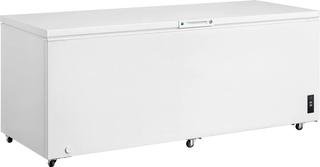
Adjust the chest freezer dial in one step
Frigidaire’s knob guidance gives a counterintuitive direction: lower numbers make a freezer warmer and higher numbers colder. It recommends small changes and a full 24 hours for stabilization. That instruction applies to the knob control described by Frigidaire; do not use it on a digital chest freezer without checking that model’s manual.
Use a thermometer to establish the cabinet temperature before touching the dial. A freezer that has just been installed, reconnected after power loss or loaded with room-temperature food can run continuously while cooling. Changing the dial repeatedly during that recovery makes it harder to tell whether the original adjustment worked.
Read the dial direction
For the Frigidaire knob described in its support article, turn toward a lower number to make the freezer warmer and toward a higher number to make it colder. Change the position a small amount, mark the old setting, then wait 24 hours before judging the cabinet. Do not infer that all numeric controls use this direction; digital buttons and model-specific scales require their own manual.
The warmer/cooler direction comes from Frigidaire’s knob article: lower number means warmer, higher number colder. It describes gradual adjustments rather than a fixed “correct” dial position. If the label is missing or the control is electronic, do not infer direction from another freezer’s dial.
Measure instead of judging by compressor time
Place a freezer thermometer where food is stored and compare it with the supported target in the owner guide. Frigidaire’s general freezer guidance recommends 0°F. A long-running compressor alone does not show that the dial is wrong: a recently connected freezer may need up to 24 hours to stabilize, and warm loading, frequent lid opening or a poor gasket seal increases run time.
Frigidaire recommends 0°F as the target for general freezer guidance. Check the temperature with a freezer thermometer instead of relying on the compressor sound or frost alone. Place the thermometer among stored food and allow the full 24-hour stabilization period after an adjustment.
Reduce warm-air entry during recovery
Keep the chest lid closed except when loading or retrieving items. Inspect the gasket contact around the rim and clean dirt from the sealing surface. Frigidaire lists a dirty or poorly fitting gasket and frequent openings among reasons for longer runtime. Do not add hot food; its run-time article says to add no more than 2–3 pounds of unfrozen or room-temperature food at one time.
Warm food increases run time; Frigidaire says not to add more than 2–3 pounds of unfrozen or room-temperature food at once and not to add hot items. Divide a large load into smaller additions and avoid loading beside the temperature sensor if the manual identifies one.
Separate a normal recovery from a fault
If temperature is moving toward the target during the first day, leave the control unchanged and continue monitoring. If the cabinet does not cool after 24 hours, check that the control is not OFF, the plug is seated and the outlet has power; Frigidaire warns against extension cords. Record actual temperature, room conditions, recent outage and load history before requesting service.
Frequent lid openings introduce warm air and cause longer operation. During the 24-hour test, plan retrievals and keep the lid closed. A dirty, cracked or poorly fitted gasket can also leak air; inspect its entire perimeter and clean it with owner-guide-approved care before replacing parts.
If the dial adjustment is followed by more warm loading, the test is no longer comparable; use a stable load and note additions during the wait. A thermometer trend across the full day is more informative than touching packages near the lid.