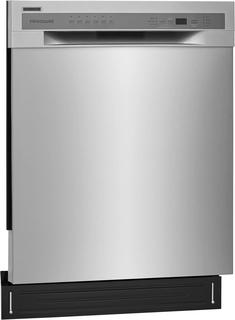
Guidance for Frigidaire dishwashers. Check the feature and control descriptions against your model.
Specifications & model details
FFBD2420US: model-specific checks
What this model’s energy figure means
Frigidaire FFBD2420US is listed at 240 kWh/year. Using an illustrative $0.20/kWh, that is $48.00 per year, or $4.00 per month, on the source’s annual test basis. For your rate, multiply 240 by your electricity price per kWh. Compare labels from the same test method; age, actual use, water heating and load choices can change the household result.
Estimate cost from your dishwasher’s energy, water, cycle frequency, and local rates using owner inputs instead of generic price averages.
Owner guide: Running cost calculator
Category & symptom guidance
Running cost calculator
4 minute read · Shared guidance for dishwashers
Gather the inputs that matter
Find the energy and water figures for the exact dishwasher or candidate model from its product information or the DOE comparison guidance. Note the stated test basis and whether figures are annualized. Do not mix an annual estimate with a per-cycle figure as if they were the same unit. If the source describes a rating cycle, your household’s use of other cycles and options can differ from the published assumption.
Collect your electricity rate in dollars per kilowatt-hour and water/sewer rates in the units your bill uses. For a rough household estimate, also note how many cycles you run in a typical week or month. If a bill uses tiered rates or separate water and sewer charges, calculate with the applicable marginal rate for added use rather than assuming one national price.
Use a transparent calculation
If the energy source gives annual kilowatt-hours, multiply that figure by your electricity rate to estimate annual electricity cost: annual kWh × dollars per kWh. If it gives energy per cycle, multiply by cycles per year first, then by your rate. Convert weekly runs to annual runs by multiplying by 52; monthly runs can be multiplied by 12. Keep the calculation in a worksheet so another person can see which inputs came from the rating and which came from your household.
For water, use the source’s annual gallons if available and multiply by your combined water and sewer price per gallon. If your bill quotes a price per thousand gallons, divide that rate by 1,000 before multiplying. For per-cycle gallons, multiply by the number of annual runs. Treat this as an estimate because household habits, utility billing tiers, and water-heating arrangements can change actual costs.
Annual water estimate = annual gallons × combined water/sewer rate per gallon.
For per-cycle figures, multiply each per-cycle quantity by estimated annual cycles before applying the rate.
Add only the cost categories actually included in your source figures; label any omitted hot-water or other household energy separately.
Adjust for the way you run it
A published rating usually represents a defined test pattern, not every possible cycle and option. The GE GD*640–670 and PD*705–795 manual, for example, states that cycle time varies with soil, inlet water temperature, and selected options; it also describes longer times for certain temperature and drying choices. That does not provide a universal energy premium for those choices, so do not invent one. If your household routinely uses options that differ from the rated cycle, present the published-based estimate as a reference and explain that actual consumption may vary.
For a more useful owner estimate, record a representative month of runs and note the cycle and options selected. If you have a dishwasher-specific energy reading from an appropriate meter or utility program, use that measured value and document its period. Do not infer energy from cycle duration alone: heating demand and water use differ, so a longer cycle is not a direct cost multiplier.
Compare old and new on equal terms
To compare replacing an existing dishwasher with a candidate, use the same household run count and the same utility rates for both. Use each model’s own published energy and water figures, and keep test bases visible. If the old model has no comparable label data, identify that gap rather than assigning it an assumed consumption value. A measured reading can improve the old-machine estimate if it covers representative cycles and the measurement method is suitable.
Calculate estimated annual cost for each machine, then subtract candidate cost from current cost to get a projected difference. If the candidate’s first cost is also being considered, divide the added purchase cost by the estimated annual operating-cost difference only when that difference is positive; the result is a simple payback estimate, not a guarantee. Exclude installation, repair, financing, disposal, and future rate changes unless you enter actual owner-specific amounts.
Keep a range when inputs are uncertain
If cycle frequency changes seasonally, calculate a lower-use and higher-use case from your own plausible run counts. Apply the same low and high assumptions to every machine in a comparison. For rates, use the current bill’s relevant charges, and state the billing period; if the utility uses tiers, the next added cycle may fall into a different tier than the average rate.
Separate measured facts from assumptions in the result. A concise report can show source rating, household cycles per year, electricity rate, water/sewer rate, estimated annual cost, and the assumptions omitted. This makes the estimate easy to update when a rate changes or the household’s run pattern shifts. Do not present the result as a guaranteed saving or use it to promise a particular payback date.
What to do with what you find
The candidate and current dishwasher have comparable annual figures and household cycle volume is known.
A rate-based operating-cost comparison can be calculated with owner inputs.
Apply the same rates and run count to both models and show the calculation.
Only cycle length is known for a selected option.
Duration alone does not establish its energy cost.
Do not assign a cost premium; use a measured reading or report the uncertainty.
Have these details ready
Model-specific energy and water figures with units and test basis
Current electricity and water/sewer rates
Household annual cycle count or representative measurement
Actual purchase cost difference if calculating simple payback
Common questions
Can I estimate energy cost by multiplying cycle hours by my utility rate?
No. The rate applies to energy consumed, not elapsed time. Use kWh figures or a suitable measured energy value.
Should water and sewer be combined?
For an owner estimate, combine the applicable charges per unit of water if both are billed by use, and keep the units consistent.
General background sources
These sources support the shared guide. Exact model specifications and matched family procedures have their own sources above.