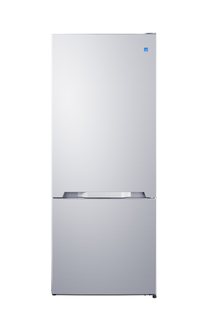
Specifications for FFBF151W with owner checks for this product design. Use the matching manual for control sequences and replacement parts.
Specifications & model details
FFBF151W: model-specific checks
Plan with this model’s measurements
For Summit FFBF151W, the source gives width 27.6 in (701.0 mm), height 68.1 in (1,729.7 mm). Measure the narrowest doorway, turning space and final opening using those same directions. These are product measurements; add the separately specified hose, ventilation, door/lid, handle and service space.
Survey the delivery route and kitchen opening before purchase, including turns, handles, door swing, and manufacturer-specific clearance requirements.
Owner guide: Dimensions & fit
Category & symptom guidance
Dimensions & fit
5 minute read · Shared guidance for refrigerators
Start at the curb and trace the route
A refrigerator has to pass every part of the delivery route, not just the kitchen doorway. Walk from the curb or building entrance to the intended location and note gates, stairs, hallways, elevator doors, and narrow turns. Measure the narrowest usable width and height at each point, accounting for trim, handrails, and protrusions that cannot be moved. Record a route measurement at the tightest point rather than relying on a floor plan.
At a turn, the appliance may need more room than the straight opening suggests. Measure the space available on both sides of the corner and note whether a door, railing, or wall prevents rotation. Delivery teams may have their own survey requirements, so give them the route measurements and ask what dimensions they need to assess access.
Walk the complete path and list every doorway, turn, stair, and elevator opening.
Measure the narrowest clear width and height, including permanent obstructions.
Measure the kitchen opening and cabinet space
Measure the refrigerator opening at several points: near the floor, around the middle, and higher up. Walls and cabinets may not be perfectly square, and trim can reduce the usable opening. Record width, height, and depth, then compare those numbers with the candidate’s published dimensions. Keep a note of nearby counters, cabinet faces, and any baseboard that changes how far the cabinet can sit back.
Use the exact model’s dimension drawing where available. Overall dimensions may describe the cabinet body separately from handles, hinges, or doors, so identify what each published measurement includes. If the drawing does not make that clear, ask the manufacturer or retailer to clarify. Do not assume a nominal refrigerator width is its installed width.
Record opening width, height, and depth at more than one point.
Compare the measurements with the exact model’s dimension drawing and identify handle or hinge projections.
Account for doors, handles, and drawers
A refrigerator that fits between cabinets may still be difficult to use if the doors cannot open far enough. Check the door swing direction, hinge position, nearby walls, and counter edges. Consider whether a door can open enough to remove drawers or shelves for cleaning and loading. Measure the handle projection if it affects a narrow route or protrudes into a walkway.
Review the manufacturer’s drawings for door-open dimensions and any stated operating clearances. These details are model-specific. When the documentation does not provide a needed measurement, request it rather than substituting a number from another refrigerator. If your kitchen opening is beside a wall, pay particular attention to whether the hinge side has room for the door and bins to clear.
Mark the hinge side and the direction each door must swing.
Check exact door-open and drawer-access information in the product documentation.
Use model-specific clearance information
Clearance requirements can depend on the refrigerator design and installation instructions. Find the manual or installation document for the exact model and use its stated spacing requirements around the sides, top, and rear. A general buying guide may help compare appliances, but it does not establish a refrigerator’s required clearance. Do not borrow a clearance figure from a different model or treat a retailer’s generic diagram as controlling when the manufacturer supplies a model-specific document.
If the exact instructions are unavailable, contact the manufacturer or retailer with the model number before finalizing the opening plan. Record the source and the measurement you used so an installer and delivery team can work from the same information.
Find the exact model’s installation document and note its stated clearances.
Resolve any missing or conflicting dimension with the manufacturer before committing to the opening.
Prepare a route checklist and resolve obstacles
Put the measurements in a short checklist: route openings, turn spaces, kitchen opening, cabinet depth, handle projection, door swing, and model-specific clearance. Take photos of tight points with a tape measure visible, and label each image by location. Share the checklist with the delivery provider before delivery day. That gives the provider a chance to flag a route concern while there is still time to discuss options.
If documents describe a door-removal procedure, follow only the procedure that applies to the exact model and only if you can safely complete it. Otherwise ask the manufacturer or delivery provider whether qualified personnel can handle the work. Do not improvise by removing hinges, doors, or connected lines. A refrigerator that cannot pass the route needs a revised delivery plan before it arrives.
Send route measurements and obstacle photos to the delivery provider in advance.
Use door-removal instructions only when the exact model’s documentation provides them; otherwise arrange qualified help.
What to do with what you find
The narrowest route opening is smaller than the refrigerator’s published width including projections.
The unit may not pass in its normal configuration even if the kitchen opening is adequate.
Ask the delivery provider and manufacturer whether a documented door-removal procedure applies and what route dimensions they require.
The refrigerator body fits the opening, but the hinge side is close to a wall.
The door may not open far enough for normal access or drawer removal.
Check the exact model’s door-swing drawing and manufacturer clearance instructions before finalizing placement.
The installation document for the exact model is not available or gives no needed clearance value.
A generic measurement cannot reliably establish the model’s fit requirements.
Request the missing information from manufacturer support using the full model number.
Have these details ready
Route measurements from curb or building entrance through the kitchen.
Kitchen opening measurements and exact model dimensions, including projections.
Manufacturer installation document with model-specific clearance and any door-removal procedure.
Delivery provider’s assessment of the route and handling requirements.
Common questions
Is measuring the kitchen opening enough?
No. Survey the entire delivery route, including tight turns, and check door swing and handle projection at the final location.
Can delivery workers remove the refrigerator doors if it does not fit?
That depends on the model and the delivery provider. Check the exact model instructions and arrange the work with qualified personnel rather than improvising.
General background sources
These sources support the shared guide. Exact model specifications and matched family procedures have their own sources above.
refrigerators.csv; row 4417; ENERGY STAR ID 3629257
Certification dataset declaration; check manufacturer installation documents for fit and clearances.
Observed Oct 31, 2026
Check whether each value describes the cabinet, overall product, or opening. Required clearances and door movement must come from the exact installation guide.