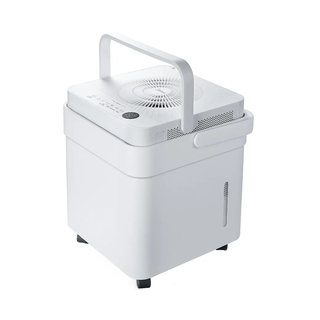
Specifications for MAD50PS1BQGR with owner checks for this product design. Use the matching manual for control sequences and replacement parts.
Specifications & model details
MAD50PS1BQGR: model-specific checks
Interpret this unit’s collection rating
Midea MAD50PS1BQGR is rated at 49.67 pints/day. This is removal over a day under the source test conditions, not the size of its bucket or an expected amount in every room. Compare room humidity, temperature, run time and whether collected water is staying in the bucket or leaving through a permitted drain. Different test standards must be reconciled before comparing pint ratings.
Compare rated moisture removal, efficiency, collection options, and practical operating features using consistent manufacturer and certification information.
Owner guide: Specifications
Category & symptom guidance
Specifications
4 minute read · Shared guidance for dehumidifiers
Separate collection from removal
A bucket’s capacity describes how much water it can hold before it needs attention. A rating in pints per day describes moisture removal under specified test conditions. These figures answer different questions: a large bucket can reduce emptying frequency, while the daily rating indicates measured extraction at the stated conditions. Do not treat a bucket size as the unit’s daily capacity.
When comparing models, find the conditions attached to each daily rating. Dehumidifier output changes with the air conditions, so a rating without its test basis may not be comparable to another listing. ENERGY STAR and Department of Energy consumer material explain why test conditions and efficiency matter. Use their standardized information alongside the product’s own specification sheet.
Write down daily removal and bucket capacity in separate columns.
Record the test conditions and source for each daily rating.
Compare efficiency on a common basis
Energy efficiency figures help compare how much water units remove for the energy they use, but only when the metric and test basis match. ENERGY STAR’s criteria describe certified performance using standardized tests. Check that both products are covered by the same metric and certification context before drawing a conclusion. A larger removal number alone does not establish lower operating cost.
For a household cost estimate, use the listed power information and your expected operating time as a rough planning input, then compare it with actual utility rates and likely use. Published ratings are not a promise of a particular monthly bill. The room’s moisture load, thermostat conditions, setpoint, and run time all affect results. Department of Energy consumer guidance emphasizes that sizing and use influence energy costs.
Compare efficiency metrics from official product or certification listings.
Use your local electricity rate and expected hours only as an estimate, not a guaranteed cost.
Treat room-area guidance carefully
Area guidance can help narrow choices, but square footage by itself does not describe a room’s moisture load. A damp basement, a dry upstairs room, and a space with frequent moisture entry may behave differently at the same floor area. Check how the manufacturer frames its recommendation, and avoid comparing unqualified square-foot figures as if they were standardized capacity measurements.
Consider the room’s use, whether doors remain open, and whether the unit is intended for a single room or a broader installation. ENERGY STAR distinguishes portable room dehumidifiers from whole-home products. Those categories reflect different applications; do not assume that a portable unit’s area claim makes it suitable for a whole house or a building system.
Note the intended product category and the manufacturer’s stated sizing assumptions.
Assess room conditions and moisture sources along with area.
Check how water is collected
A portable unit may collect water in a bucket, drain by gravity through a hose, or use a pump, depending on the model. These options affect placement and how often you must handle water. A gravity hose needs a suitable route and destination; a pump can provide more flexibility only within the product’s specified setup. Confirm that the option is built in or supported for the exact model before planning around it.
Look for operating limits and instructions in the manual, including any requirements for bucket installation or drain routing. Support guidance for one manufacturer notes that bucket and pump behavior can vary by model. Avoid assuming that a feature shown on a related unit is available on the one you are considering.
Confirm the drainage method in the model’s own specifications.
Check the manual for the hose or pump arrangement before deciding where the unit will sit.
Include noise and controls in the comparison
Noise descriptions and control features are useful for choosing a location, but they are not always measured using a common method. Compare a published sound rating only when the units use the same kind of measurement and conditions. If one listing says only “quiet,” treat that as a marketing description rather than a directly comparable number. A unit in a bedroom or work area may need a different tradeoff than one in a utility space.
Review the settings that matter to your use, such as humidity selection, fan options, timer behavior, and restart behavior after power interruption. Names and available functions vary by model. Use the manual or official product page rather than assuming controls work the same across a brand.
Check whether sound data includes a measurement basis.
List the controls you need and verify each on the exact model’s official materials.
What to do with what you find
Two listings show different daily removal ratings but use different test conditions.
The figures do not provide a like-for-like capacity comparison.
Find standardized ratings or compare both models at the same stated test basis.
A model has a large bucket but a lower daily removal rating.
It may need less frequent emptying while extracting less water per day under test conditions.
Choose based on both emptying convenience and the room’s moisture needs.
A product’s area claim is the main reason it appears suitable.
Area alone does not establish capacity for the room’s moisture load or intended product category.
Check the application category, rating conditions, and manufacturer sizing assumptions.
Have these details ready
Official product specification sheets for both candidates
Stated test conditions for moisture removal and efficiency
Manual details for drainage, controls, and intended application
Common questions
Are bucket capacity and pints per day interchangeable?
No. Bucket capacity is stored water volume; pints per day is a removal rating under stated conditions.
Can I compare energy figures across any two models?
Compare only when the metric and test basis align, and treat estimated cost as dependent on actual runtime and electricity rates.
General background sources
These sources support the shared guide. Exact model specifications and matched family procedures have their own sources above.
dehumidifiers.csv; row 481; ENERGY STAR ID 4509977
Certification dataset declaration; check manufacturer installation documents for fit and clearances.
Observed Oct 31, 2026
A comparison group built from recorded designs
Midea dehumidifiers
55 records in this manufacturer/public-source group. The group uses the brand, category and recorded design, rather than a guessed series or production year.
249.0–530.0 kWh/yearannual energy · 55 source values