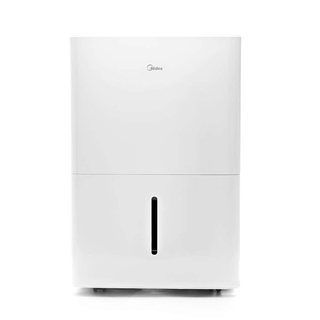
Specifications for MAD22C1AWS with owner checks for this product design. Use the matching manual for control sequences and replacement parts.
Specifications & model details
MAD22C1AWS: model-specific checks
Interpret this unit’s collection rating
Midea MAD22C1AWS is rated at 22.31 pints/day. This is removal over a day under the source test conditions, not the size of its bucket or an expected amount in every room. Compare room humidity, temperature, run time and whether collected water is staying in the bucket or leaving through a permitted drain. Different test standards must be reconciled before comparing pint ratings.
Locate where water first appears, dry the area, and check the relevant collection or drainage path using the exact model instructions.
Owner guide: Leaks, moisture & condensation
Category & symptom guidance
Leaks, moisture & condensation
4 minute read · Shared guidance for dehumidifiers
Locate the first wet point
Before moving the appliance, note where water first appears: under the cabinet, at the bucket seam, around a hose connection, or near a pump outlet. Dry the floor and the appliance exterior, then place a dry towel or shallow tray near—but not inside—the suspected area. Check again after a short period of normal operation. A puddle that begins at the bucket edge suggests a different path from water that appears below a drain fitting. Keep water away from plugs, cords, and outlets. If the floor is wet near electrical connections, switch off power only if you can do so safely without contacting water.
Document the first wet location before moving the unit.
Dry accessible surfaces and protect nearby electrical connections.
Observe where moisture returns during ordinary operation.
Check bucket seating and overflow
If moisture appears at the bucket seam or front of the unit, inspect the bucket for overfilling, cracks, or poor seating. Empty it and reinstall it according to the manual. Check that the float, if externally accessible as intended, is not visibly obstructed; do not force it. Some manufacturer instructions, including Frigidaire’s support example, address bucket seating and water collection for the models covered by that source. Apply those directions only when they match your appliance. If the bucket is cracked or the leak returns despite correct seating, stop using bucket collection and contact the maker for model-specific guidance.
Remove and empty the bucket, then inspect its visible seams and base.
Reseat it using the exact manual’s directions.
Do not use another brand’s bucket procedure unless it applies to your model.
Inspect a gravity drain hose
For a gravity-drain setup, trace the hose from the appliance outlet to its drain without disconnecting anything while the unit is running. Look for a kink, a loose connection, a split hose, or an outlet that has moved above the level required by the manual. Water can escape at a connection or back up if the route does not follow the specified setup. Frigidaire’s draining guidance is relevant to the models it covers; use its steps only if your model and connection match. Dry the fitting, correct an obvious external routing issue as the manual allows, and observe whether the connection stays dry.
Confirm the unit is configured for gravity drainage in its manual.
Inspect the visible hose and connection for kinks, looseness, or damage.
Route the outlet as the exact model instructions specify.
Check a pump outlet only if equipped
A pump-equipped unit may send water through a separate outlet. First verify from the model manual that a pump is present; do not assume the fitting belongs to one. Inspect visible tubing and the outlet for a loose connection or damage, and check whether water is reaching the intended drain. Do not detach a pressurized or active connection, open the cabinet, or pour water into the unit to test it. Some Frigidaire draining instructions describe pump setup for covered models; those examples do not establish compatibility for other products. If the outlet leaks after an external connection check, stop and ask the manufacturer about the correct service path.
Verify pump equipment and outlet identification in the exact manual.
Check visible connections while the unit is off, if the manual permits.
Contact support if a leak persists at the pump outlet.
Consider condensation or thawing frost
Moisture on a cool surface may be condensation rather than a leak from the bucket or hose. Dry the cabinet and nearby surfaces, then look for the highest or first point where water returns. Frost that later melts can also leave water; follow the exact manual if frost or a defrost indication is present. Frigidaire’s leakage support discusses frost-thaw examples for the models covered there, but do not use those examples to infer a fault or operating limit on another brand. If water returns near an electrical connection, stop using the appliance and keep clear. Record the location and conditions for manufacturer support.
Dry the area and identify whether water forms on a surface or emerges from a joint.
Follow the manual’s directions for visible frost or defrost indication.
Record the source location and stop if moisture reaches electrical parts.
What to do with what you find
Water reappears at the bucket seam after the bucket is full or reseated.
Overflow or bucket fit remains a plausible source.
Empty and refit the bucket per the exact manual; seek support if water returns with a sound bucket.
Water first appears at a visible hose connection or along the hose.
The drain route or an external hose connection may be involved.
Turn the unit off and inspect the visible hose for damage or routing issues allowed by the manual.
Moisture appears near the cord, plug, or outlet, or the source cannot be safely isolated.
Water is close to an electrical hazard or requires internal access to investigate.
Stop operation, keep clear of wet electrical areas, and contact qualified support.
Have these details ready
Exact first wet location and when it returns
Bucket condition and collection mode
Visible hose or pump outlet configuration
Photos of external connection and model label
Common questions
Can I apply Frigidaire hose steps to another brand?
Only use them if the setup and model are explicitly covered. Otherwise, follow your own model’s manual.
How do I tell condensation from a leak?
Dry surfaces and observe where moisture first returns. Water emerging from a seam or fitting points to a different source than moisture forming across a cool surface.
General background sources
These sources support the shared guide. Exact model specifications and matched family procedures have their own sources above.