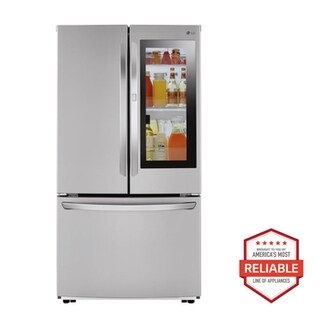
Brand-category guidance for LG refrigerators. LG’s lineup varies by configuration and feature package, so feature-specific instructions are gated by the exact model.
Total Capacity (cu.ft.)
22.8 cu.ft. cu ft
Width
35.75" in
0 detailed family articles9 short family notes40 detailed owner guides
Detailed articles use sources for the named brand and product family. Short notes add family details to shared guidance. Owner guides cover the product category and recorded design, with this model’s measurements and brand details shown separately. Exact controls and part fitment require a matching manufacturer source.
LG’s refrigerator lineup spans French-door, side-by-side, and other configurations, with feature availability varying by product. Read the full model code from the rating label before searching support or ordering a water filter. A...
LG’s buying guide distinguishes refrigerator layouts and describes features such as convertible drawers, different ice arrangements, InstaView, and ThinQ connectivity across selected models. Compare the exact model page for capacity and...
Use the full refrigerator model and serial information to find documentation, then choose the document that matches the job. Check applicability and revision before using instructions, especially for installation or service.
Use the exact LG product specification for total height, width, depth, and any depth measurement with doors or handles. For a French-door model, confirm that both doors and interior drawers can open in the intended location; a tight...
Plan the refrigerator’s location, support, leveling, access, exposure, and required connections using the exact model instructions and qualified help where work exceeds owner capability.
Compare the refrigerator’s own electrical rating with the receptacle and the information your installer or electrician can verify. The nameplate describes the appliance; it does not certify the wiring in your home.
Plan a refrigerator move around food safety, removable interior parts, the route and lifting method, and any connected water line. Follow the exact model’s transport and restoration instructions, then verify food-safe temperatures...
LG refrigerator options vary: selected models have ThinQ, InstaView viewing panels, convertible drawers, or different ice and water arrangements. During setup, record which features your exact product has and use its manual for initial...
When food seems too warm or cold, record refrigerator and freezer settings, which compartment is affected, and whether doors were recently open or groceries were loaded. LG’s cooling troubleshooting treats airflow, door closure, and...
LG refrigerator exteriors include different finishes and some models add tinted InstaView glass or dispenser surfaces. Use care instructions for the exact finish and avoid abrasive tools or cleaners on the display or tinted panel. Wipe...
LG’s cooling guide emphasizes visible owner checks such as door closure and airflow. Look for packages blocking vents, debris at an accessible gasket surface, and moisture near the dispenser or supply area. Record whether condensation...
Prepare a refrigerator for a power outage or planned absence by protecting food, cleaning and drying it appropriately, and checking operation when power returns.
Use measured temperatures and visible airflow, door, frost, water, and sound clues to decide what you can safely correct and when a technician is needed.
Separate a cooling problem from an accessory problem
Measure both compartments before changing controls
LG’s cooling support asks owners to check settings, door closure, and visible airflow conditions. Note whether the display and interior lights operate, whether one or both compartments are warm, and any displayed code. This creates a...
LG publishes refrigerator code references for named conditions and product families. Photograph the complete code and note whether cooling, ice, or water functions changed at the same time. Search support using the full model number and...
Track where and when a refrigerator sound occurs, check visible contact points, and use changes in the sound pattern to decide whether to seek service.
Trace refrigerator moisture by where it appears and when it returns. Check common owner-visible sources, dry the area, and observe the pattern without removing panels.
Use visible signs to distinguish a refrigerator with no apparent power from one whose controls are unresponsive. Check accessible household power safely and stop if wiring is damaged.
Tell a dark refrigerator from an unresponsive control
Judge cooling performance with repeatable temperature readings, food impact, and visible loading patterns. Separate ordinary unevenness from a persistent temperature or frost concern.
Identify a refrigerator part from the full model information and parts diagram, then verify the exact fit and function before ordering. Separate owner-removable items from internal components.
Start with the complete model identity
Use the diagram to identify the position
Separate owner-removable items from internal parts
Plan replacement only when the component is documented as owner-serviceable. Verify identity and return terms first, and route internal plumbing, wiring, and cooling work to a qualified servicer.
Verify replacement refrigerator parts by model, part number, revision, dimensions, interface, and certification where relevant; appearance alone is not enough.
Use parts illustrations to identify components and installation drawings to understand placement; leave wiring and service schematics to qualified technicians.
Compare written refrigerator repair estimates by scope, fees, parts, labor, warranty, downtime, and household costs without relying on unsupported price averages.
Use a household worksheet that weighs condition, repair scope, replacement cost, energy use, fit, food needs, and downtime rather than relying on a simple age cutoff.
Use the EnergyGuide estimate as a comparison point, then account for your household’s habits and electricity rate. Compare usable capacity and configuration alongside annual energy use, and avoid treating a label as a promise about your bill.
Estimate refrigerator electricity cost from the annual kWh label and your utility rate. Keep label-based estimates distinct from actual use, account for billing periods and variable rates, and compare models with matching assumptions.
Verify coverage using the exact model, serial number, purchase date, and warranty document. Separate parts, labor, and sealed-system terms; preserve proof and make a clear support case through the retailer or manufacturer.
Identify the exact refrigerator and purchase date
Read parts, labor, and sealed-system terms separately
Search official recall information using the exact model and serial details, then follow the notice’s stop-use and remedy instructions. Distinguish a formal recall from a general support alert and preserve evidence of the product identity.
Establish a refrigerator’s history from its label, dated purchase records, and official brand support. Serial formats vary, so decode a manufacture date only when the brand provides a reliable official method.
Select qualified refrigerator service by confirming authorization, understanding the diagnosis and repair terms, and planning for food during downtime.
Find a qualified provider for your exact brand
Ask what the diagnostic visit includes
Keep sealed-system and electrical work professional
Arrange a refrigerator’s removal through a retailer, municipal program or appliance recycler that can handle refrigerant and secure the appliance safely.