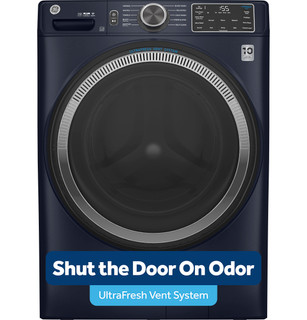
Use the front-loader’s dispenser and cycle as designed
The GFW550 manual’s UltraFresh Vent with OdorBlock feature is intended to reduce excess moisture around the gasket and washer after laundry is removed; the door stays locked while it runs. If garments remain in the basket, the manual says the machine switches to Tumble. Use this feature only when the panel offers it and the basket is empty.
Use the front-loader’s dispenser and cycle as designed
The GFW550 manual’s UltraFresh Vent with OdorBlock feature is intended to reduce excess moisture around the gasket and washer after laundry is removed; the door stays locked while it runs.
Use this feature only when the panel offers it and the basket is empty.
GE GFW550SPRRS is listed as . For this recorded front-loading GE design, inspect the accessible door glass and seal, drawer opening and visible hose connections. For a wet load, first establish whether water remains in the drum. Door locking, spin selection and pump-filter access are distinct checks; use only the access points described for the actual unit.
Poor cleaning, residue, odor, and excess suds often respond to changes in loading, detergent, cycle, and maintenance. Diagnose the actual symptom before changing several things at once.
Owner guide: Poor performance
Category & symptom guidance
Poor performance
3 minute read · Shared guidance for washing machines
Name the performance problem
Separate visible soil left on fabric from detergent residue, lint transfer, color bleeding, odor, and clothes that remain too wet. Each points to a different combination of cycle choice, load size, product amount, water conditions, or drainage. Note whether the problem affects every load or only one fabric type or cycle.
Compare similar loads using the care labels and the washer’s intended cycle. A delicate cycle may clean gently but not provide the same wash action as a regular soil-removal cycle. Avoid adding more detergent as the first response; too much can cause suds and interfere with rinsing.
Tune loading and detergent
Load items loosely so water and wash action can reach them. On an agitator top-loader, avoid wrapping bulky articles tightly around the center post; on an impeller top-loader, distribute clothing around the wash plate. A front-loader needs room for tumbling, and overpacking can leave soil or detergent behind. Follow the garment care label, especially for items that are waterproof or water resistant.
Use detergent labeled for high-efficiency machines when the washer calls for it, and measure according to the detergent label and the washer’s load guidance. Reduce the amount for a small or lightly soiled load when the product instructions support that adjustment. Hard water, soft water, concentration, and load size can change the useful amount; there is no one dose that fits every household.
Match cycle and water expectations
Choose a cycle based on fabric and soil rather than the amount of water visible through a lid or window. HE washers are designed to use less water than conventional designs, so clothes may not be submerged during the wash. That alone does not show poor performance. If detergent is not dissolving well in very cold household water, review the product directions and choose a permitted temperature suited to the fabric.
For a top-load sensing washer, let the sensing phase finish before judging fill level. Whirlpool’s general sensing guidance explains that sensing can determine water needs based on load characteristics; the amount may appear lower than expected. That page is broad guidance, not a guarantee about every washer’s sensing behavior.
Address residue and odor systematically
If garments feel slick or show streaks, test a smaller measured detergent amount and avoid overloading. If lint transfer is the problem, separate lint-producing towels from lint-catching fabrics and check pockets before washing. For a front-loader, wipe the visible door seal and leave the door and dispenser open to air when the cycle is finished, if the household setup allows; follow the manual for cleaning and any maintenance cycle.
Change one factor at a time and compare a similar load. If performance worsens across balanced loads despite suitable detergent and cycles, or water remains in the machine, treat it as a possible fill, drain, or wash-action fault rather than continually adding products.
What to do with what you find
Poor results occur with overloaded or tightly bunched laundry.
Wash action and rinsing may be restricted by loading.
Try a smaller, loosely arranged load using a suitable cycle.
Suds or residue increase after adding extra detergent.
Excess detergent may be reducing rinse quality.
Measure a smaller amount consistent with product and washer directions.
Results remain poor across ordinary balanced loads and appropriate settings.
A recurring washer or household water issue may be present.
Compare whether filling, draining, or spin also behaves abnormally and seek diagnosis.
Have these details ready
Specific result: soil, residue, odor, lint, or wet clothes
Load size and fabric mix
Detergent type and measured amount
Cycle, temperature, and whether the symptom repeats
Common questions
Why is the water level lower than my previous washer?
Many high-efficiency washers use less water by design, and sensing models adjust fill to the load. Visible water level alone is not a reliable measure of cleaning performance.
Should I add more detergent if clothes are still dirty?
Not automatically. Excess detergent can create suds and residue. Check loading, soil-appropriate cycle, product directions, and dose before increasing it.
General background sources
These sources support the shared guide. Exact model specifications and matched family procedures have their own sources above.