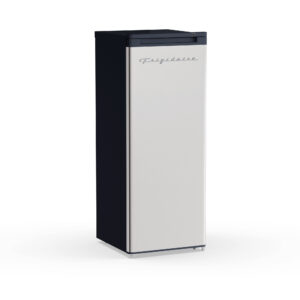
Guidance for Frigidaire freezers. Check the feature and control descriptions against your model.
Specifications & model details
EFRF694: model-specific checks
Plan with this model’s measurements
For Frigidaire EFRF694, the source gives width 22 in (558.8 mm), height 56 in (1,422.4 mm), depth 22 in (558.8 mm). Measure the narrowest doorway, turning space and final opening using those same directions. These are product measurements; add the separately specified hose, ventilation, door/lid, handle and service space. The reported width × depth occupies about 3.36 square feet before those allowances.
Frigidaire EFRF694 is recorded as upright. Check the door swing, shelf or drawer seating, and packages projecting into the seal. For uneven cooling, keep the source-listed defrost design in view: airflow checks apply to a fan-cooled layout, while a manual-defrost layout has its own unloading and defrost procedure.
Measure the route, cabinet space, and door movement, then confirm clearances in the exact freezer manual.
Owner guide: Dimensions & fit
Category & symptom guidance
Dimensions & fit
3 minute read · Shared guidance for freezers
Measure the delivery route first
Measure doorways, hallways, turns, stair openings, and the final approach to the installation area. Compare those measurements with the freezer’s shipping and cabinet dimensions in the exact product specification. Packaging can make the delivered unit wider or taller than the bare cabinet, so ask the seller or carrier for packed dimensions if the route is tight.
Check thresholds and corners as well as the narrowest opening. A freezer that fits the final space can still be impossible to turn into it. Do not assume that a unit can be safely tilted or laid down; use the manufacturer’s transport instructions for the exact model.
Measure the tightest width and height along the route, including door stops and handles.
Confirm delivery access and any required handling instructions with the seller or carrier.
Check the cabinet footprint and opening
Measure the width, depth, and height of the intended location, then compare them with the freezer’s listed dimensions. Leave room for the cabinet to be positioned and leveled. An upright requires space for its door to swing and for you to stand in front of the shelves; a chest needs lid clearance above it and room to reach the basket and bottom of the compartment.
Measure handles and protrusions when they affect passage or nearby walls. A snug cabinet footprint is not enough if a lid strikes a shelf overhead or an upright door cannot open far enough to remove bins. Keep the manufacturer’s stated installation clearances separate from the room needed for everyday access.
Mark the freezer’s outline and door or lid arc on the floor or wall with removable tape.
Check access to the plug and any service area after the freezer is in place.
Apply the clearance for the exact model
Clearance requirements are model-specific. The Danby DUFM085A2BSLDD upright guide specifies 4 inches at the rear, 8 inches at each side, and 12 inches above for that model. Those figures must not be transferred to another Danby upright or to a chest freezer.
For another appliance, use its own manual and allow the airflow space it specifies. ENERGY STAR comparison information can help evaluate products, but it does not replace a manufacturer’s installation dimensions. If the manual gives separate guidance for ventilation, service access, or opening movement, account for each.
Find the installation diagram or clearance paragraph in the exact model manual.
Measure the required gaps from the points the manual identifies, such as cabinet edges or rear panel.
Plan for floor, level, and usable access
Check that the floor is firm and level enough for the freezer and its loaded weight. The Danby DUFM085A2BSLDD guide describes leveling legs for that upright; other models may use different feet or instructions. Use the method in the exact manual, especially if the door must close and seal reliably.
Think about what must remain reachable after installation: the receptacle, a drain fitting if the model has one, and the interior space needed to remove baskets. Upright shelves make access more visible but need door-swing room; chest freezers can be easier to place where a side-opening door would collide with something, but the lid needs overhead room.
Check for floor slope and obstructions before delivery.
Plan a stable position that permits the door or lid to open fully and close without interference.
Recheck fit before ordering
A final fit check should include the full model’s dimensions, packaging route, required installation gaps, door or lid movement, and the location of the electrical outlet. Product pages and manuals may list different kinds of dimensions, so identify whether a figure describes the bare appliance, handle, or packaging before relying on it.
Compare freezer options by dimensions and energy information together. ENERGY STAR provides a way to compare freezer products, while manufacturer documentation supplies the fit details for a particular model. For an online order, confirm the exact model and delivery terms in the listing and order record.
Keep the route measurements and final-space measurements with the product listing.
Reconfirm model, dimensions, and delivery conditions before the return window begins.
General background sources
These sources support the shared guide. Exact model specifications and matched family procedures have their own sources above.
Regulatory archive observation; test standard and measurement context follow the original record.
Observed Oct 27, 2026
Check whether each value describes the cabinet, overall product, or opening. Required clearances and door movement must come from the exact installation guide.