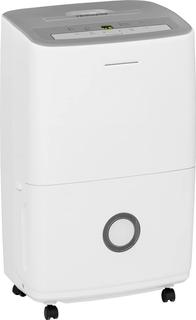
Frigidaire’s support describes both bucket collection and gravity-hose drainage. It calls for a 1/2-inch-or-larger hose, routed below the unit connection without kinks, because narrow hoses can clog and trigger a full-bucket condition. For storage, Frigidaire recommends draining and washing the bucket, disconnecting hoses and drying them before reuse.
0 detailed family articles8 short family notes40 detailed owner guides
Detailed articles use sources for the named brand and product family. Short notes add family details to shared guidance. Owner guides cover the product category and recorded design, with this model’s measurements and brand details shown separately. Exact controls and part fitment require a matching manufacturer source.
The support instructions cover the brand’s dehumidifiers but do not establish that every portable model has the same continuous-drain cap or pump. Read the rating label and manual before buying a hose or diagnosing a pump; use the...
Compare rated moisture removal, efficiency, collection options, and practical operating features using consistent manufacturer and certification information.
Use the appliance’s full label code to locate the right owner documents, then verify model family, region and revision before applying any instruction.
Frigidaire says its dehumidifier drains from the collection tray by gravity when the continuous-drain cap is replaced with a hose. Route the hose below the connection, flat and as straight as possible; a small-diameter hose is more...
Prepare the dehumidifier for transport by removing water, securing loose items and protecting floors, then follow the exact model’s transport and restart guidance.
Set the dehumidifier on a stable surface, install its removable parts, choose a supported drainage method and confirm that it collects water as expected.
Read the control panel using the exact manual, distinguish a humidity target from a measured reading, and change settings one at a time while observing the result.
Tell a target from a room reading
Understand automatic and continuous operation
Read fan, temperature and defrost options in context
Tell a power restart from an automatic stop, a full-bucket trip, or a factory reset. Preserve settings and clear a stop condition only as the model’s manual directs.
Frigidaire instructs owners to disconnect power before wiping the cabinet, and warns that excess water near controls or vents can damage the unit. Use an oil-free cloth or mild soap and water; do not use bleach or ammonia.
Frigidaire recommends washing the bucket with mild soap and water; for pump-equipped models it says this reduces likelihood of pump blockage. Bucket disassembly depends on the owner manual, so use the unit-specific directions before...
Check the exact model before buying a filter, bucket, hose, or pump accessory. Parts differ, and reusable mesh filters may have different care instructions from replaceable filters.
Use the exact model’s parts reference to identify a replacement. Unplug before handling user-accessible parts, avoid force, dry washable components fully, and verify the fit and collection setup afterward.
Before storing a Frigidaire dehumidifier, disconnect power and any drain hoses, drain and wash the bucket, and let parts dry for one or two days when possible. The company recommends cleaning the filter and flushing drain hoses before...
Limit owner checks to visible, user-accessible parts and the manual. Record what the unit does and where water collects; leave electrical, sealed-system, and internal repairs to qualified service.
A Frigidaire dehumidifier may show Full Bucket when the bucket is full, but the maker also says a blocked continuous-drain hose can back water up into the bucket and trigger that light. Check hose slope and blockage before assuming the...
Frigidaire notes dust in collected water can form sludge or algae that blocks the hose. Flush the hose with clean water periodically. If water is appearing on the floor, stop the unit and check bucket seating and hose blockage before...
Separate a blank display from a powered unit that will not start, then check safe external power, bucket fit, controls, and model-specific operating conditions.
Work out whether high room humidity reflects the room’s moisture load, the way air reaches the dehumidifier, or a machine that is not collecting water as expected.
Frigidaire’s cleaning article distinguishes pump-equipped dehumidifiers when describing bucket care. That means a drain pump should not be presumed present just because another Frigidaire model has one. Check the full model manual and...
Plan straightforward replacement of documented owner-accessible parts, and set a clear service boundary for internal electrical, pump, or refrigerant work.
Decide whether the part is owner-accessible
Prepare for water and power safely
Replace filters, buckets, and hoses by documentation
Verify substitutes using exact model and part numbers, connection specifications, manufacturer confirmation, and a return policy rather than visual similarity.
Use the complete product and part identifiers
Compare hose connection specifications, not appearance
Compare portable and whole-home options against the spaces, drainage, electrical access, noise limits, and storage needs you actually have. Check successor fit and compare rated capacity and efficiency on a like-for-like basis.
Compare the complete purchase and ownership cost, including included parts, delivery, haul-away, returns, warranty terms, and operating costs. Check used condition and recall status before paying.
Use qualified service for internal electrical, fan, pump, or sealed cooling-circuit work. Get a written diagnostic and itemized quote, confirm refrigerant repair capability and warranty effects, then compare repair with replacement.
Find a local program or hauler that explicitly accepts dehumidifiers and handles refrigerant-bearing appliances appropriately. Prepare the unit safely and follow any exact-model recall disposal instructions.