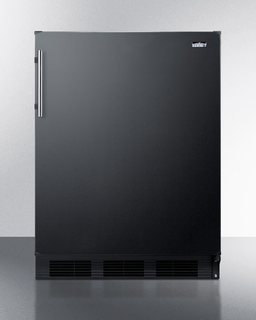
Specifications for CT663B with owner checks for this product design. Use the matching manual for control sequences and replacement parts.
Specifications & model details
CT663B: model-specific checks
What this model’s energy figure means
Summit CT663B is listed at 365 kWh/year. Using an illustrative $0.20/kWh, that is $73.00 per year, or $6.08 per month, on the source’s annual test basis. For your rate, multiply 365 by your electricity price per kWh. Compare labels from the same test method; age, actual use, water heating and load choices can change the household result.
Use the EnergyGuide estimate as a comparison point, then account for your household’s habits and electricity rate. Compare usable capacity and configuration alongside annual energy use, and avoid treating a label as a promise about your bill.
Owner guide: Energy, water & efficiency
Category & symptom guidance
Energy, water & efficiency
5 minute read · Shared guidance for refrigerators
Read the annual energy estimate in context
A refrigerator’s EnergyGuide annual kilowatt-hour figure is a standardized estimate for comparing models. It does not predict the exact energy a particular household will use. Your bill depends on the appliance’s actual consumption, your electricity price, and how your utility bills you. Start by recording the annual kWh figure for each model you are considering. Compare models with similar capacity and features so the figure answers a useful question: how much energy does each configuration use under the label’s comparison conditions?
To translate a difference into a rough annual cost difference, multiply the kWh difference by your rate per kWh. For example, a 100 kWh annual difference at $0.18 per kWh is about $18 per year. This is a scenario, not a guaranteed saving. If your rate changes by time of day or season, the calculation using one rate is only an approximation. Keep the assumptions beside the result so you can revise it with your actual bill rate.
Write down annual kWh and stated capacity for each candidate.
Calculate annual cost with the same electricity rate for each model.
Compare capacity and configuration together
A low annual kWh number alone can mislead if the refrigerator is too small for the household or if its layout makes everyday use awkward. Compare capacity as well as energy use. The DOE Federal Energy Management Program recommends considering annual energy consumption and capacity when comparing refrigerators. Check how much fresh-food and freezer space the listing provides, and decide whether the arrangement fits the food you routinely store.
Configuration can also change how people use the appliance. A freezer location, door arrangement, or dispenser may suit one household better than another. Features can affect both purchase cost and energy use, so compare like with like where possible. If one model includes extra features and another does not, note that difference instead of attributing all energy variation to efficiency. The practical choice is the model that meets your storage needs while using less energy under comparable conditions.
Compare annual kWh among models with the capacity you actually need.
List configuration and included features that differ before judging the energy figures.
Look at loading and door routines
Everyday habits affect how a refrigerator performs in a home. Frequent or prolonged door opening lets conditioned air escape, and putting away a large amount of warm food creates additional cooling work. That does not mean you need to avoid normal use; it means the label figure may not match a household that opens doors often or regularly loads large grocery trips.
Keep frequently used items easy to find, close doors promptly, and avoid blocking interior airflow with tightly packed food. Follow the owner’s manual for storage and loading guidance because interior layouts vary. If you are comparing bills before and after a change in habits, compare similar billing periods and note differences in weather, household occupancy, and usage. A single month is a poor basis for claiming a precise annual saving, particularly if the utility rate or billing period changed.
Notice whether doors are often left open while people decide what to take.
Arrange food so you can find items quickly and keep vents clear as the manual directs.
Choose settings from the manual and food needs
Settings affect both food storage and energy use, so do not choose them based on an assumed universal dial position or a guessed temperature. Use the manufacturer’s instructions for the exact model and check food-safety guidance from the FDA. A refrigerator thermometer can help you assess the food compartment rather than relying only on a control display or dial, which may not show the actual temperature everywhere.
If stored food seems warmer than expected, verify the temperature with an appropriate thermometer and consult the manual before changing settings. Make one adjustment at a time, then allow the appliance to settle according to the manufacturer’s instructions before assessing the result. Do not raise settings simply to reduce energy use if doing so compromises safe food storage. The FDA’s refrigerator guidance gives food-safety context; the model manual governs how to operate that appliance.
Check the model manual for recommended controls and thermometer placement.
Use FDA refrigerator guidance to assess food-storage safety.
Estimate scenarios without promising savings
A useful comparison is a short set of scenarios based on your own rate and likely use. If model A is labeled at 500 kWh/year and model B at 450 kWh/year, the 50 kWh difference multiplied by $0.18/kWh is $9 per year under that rate assumption. Over five years, the simple arithmetic is $45, but it assumes the rate and consumption difference remain constant. It does not include purchase price, repairs, or changes in household use.
You can make the estimate more realistic by using the rate from a recent bill and noting whether it varies. Compare an annual label estimate with your actual bills only as separate evidence: the label supports model-to-model comparison, while bills reflect the whole home unless the refrigerator is separately metered. Avoid claiming that one habit or feature guarantees a fixed reduction. Use the calculation to inform a purchase decision, then treat actual bills as the outcome to observe over time.
Record the rate and kWh assumptions next to each scenario.
Use consistent years, rates, and capacity assumptions when comparing models.
What to do with what you find
Two similarly sized models have different annual kWh estimates.
The lower label estimate indicates lower standardized annual energy use for the comparison, but does not guarantee the same difference in your home.
Calculate the cost difference using your electricity rate and compare features and capacity.
Your bill’s total use differs from the refrigerator’s label estimate.
The bill covers household electricity and may reflect rate changes, weather, or other loads; it cannot isolate refrigerator consumption by itself.
Compare similar billing periods and keep the label estimate separate from whole-home usage.
A thermometer shows the food compartment is warmer than expected after a setting change.
The current setting or usage conditions may not maintain appropriate food storage temperature.
Follow the exact model manual and FDA food-safety guidance; restore safe storage conditions before optimizing energy.
Have these details ready
Exact model’s annual kWh and capacity from product labeling
Recent utility bill rate and whether rates vary
Owner’s manual for settings and loading guidance
Thermometer reading and date if assessing storage conditions
Common questions
Does the EnergyGuide annual kWh number predict my bill?
No. It is a standardized comparison estimate. Your cost depends on actual use, your utility rate, and how the utility bills you.
Can I raise the temperature setting to save energy?
Only use settings consistent with the model manual and safe food storage. Verify with a thermometer and consult FDA guidance rather than guessing.
General background sources
These sources support the shared guide. Exact model specifications and matched family procedures have their own sources above.