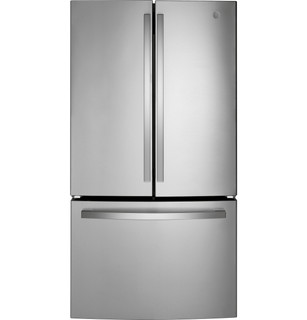
If both sections are warm, first note whether the compressor control is at OFF and whether the unit recently lost power. If only fresh food is warm while the freezer is cold, blocked airflow or the damper/control path is a more useful observation than guessing at a compressor. GE manuals and controls differ by age and configuration.
Freezer food is frozen but the refrigerator compartment is warm.
On many legacy layouts, freezer air feeds the fresh-food side through a damper; the two symptoms are not equivalent.
Clear visible air openings and report which compartment is affected.
GE GWE22JYMFS is listed with Frost Guard defrost. Use the branch for the listed defrost system. Note whether frost is confined to a door edge, covers stored packages, or returns on an interior surface. Door closure, moisture entry and a defrost-system problem produce different patterns.
GE GWE22JYMFS lists GE Water Filtration (XWFE Filter); Water Filter Indicator Light; Certified to reduce 70+ impurities including lead, chlorine, PFOA/PFOS, microplastics, arsenic, and select pharmaceuticals. (impurities not necessarily found in all users’ water) as its water filter. Check the installation and replacement requirements for that identifier when investigating water flow or maintaining the water path. A filter identifier is not evidence that replacing it will cure a cooling or ice-production fault.
Confirm the dispenser is a feature, compare it with other water outlets, and inspect the filter, accessible line, and recent installation history. Distinguish no flow from reduced flow without opening the appliance.
Owner guide: Refrigerator water dispenser not dispensing
Category & symptom guidance
Refrigerator water dispenser not dispensing
5 minute read · Shared guidance for refrigerators
Confirm the dispenser and compare water flow
Check that your refrigerator has a water dispenser and that you are using its intended outlet. Some models have no dispenser, while others place it inside the refrigerator or use a different arrangement. Consult the manual or model information before treating an unfamiliar opening as a failed dispenser. If the feature is present, compare the symptom carefully: no flow means no water comes out; reduced flow means water does come out but more slowly or in a weaker stream than usual. Note whether the change began suddenly or gradually.
Check a nearby household cold-water tap. If it also has no flow, the interruption may be upstream of the refrigerator. If the tap works, check any other refrigerator water outlet only if the model has one. These comparisons do not identify an internal fault, but they show whether the symptom is limited to one outlet or affects the refrigerator’s water supply more broadly.
Inspect the filter and its housing
If the symptom began after a filter change, check the manual to confirm the correct filter procedure for your model and whether the filter is fully seated. A filter that is not installed as directed may interrupt or reduce flow. Do not assume a filter is present or that every model uses the same fitting. Look for visible water around the filter area and stop if you find a leak. Avoid removing covers or forcing the filter into place.
If the filter has been in use for some time, consult the model’s instructions for replacement guidance rather than relying on a universal interval. A reduced stream can be a reason to check filter history, but it does not prove the filter is the cause. Record when it was changed, the filter identification if available, and whether flow changed immediately afterward. If there is no filter access intended for the owner, leave the housing closed and report the symptom to service.
Check accessible supply and visible leaks
Look only at the shutoff and tubing you can see without moving the refrigerator or removing panels. Confirm whether an accessible shutoff appears open, and look for a kink, crushed section, dampness, or a puddle along the exposed line. A closed shutoff can explain no flow; a kink or restriction may contribute to reduced flow. Do not disconnect tubing, reach behind a heavy appliance, or test fittings with tools.
If you see water, stop using the dispenser and close an accessible shutoff only if you can reach it safely. Contact the installer or a qualified service provider. If the shutoff is open and visible tubing looks sound, that does not establish that water is reaching the dispenser internally. Keep that result as evidence and continue with the filter and recent-work checks rather than opening the refrigerator.
Consider recent door or installation work
Ask whether the refrigerator door was recently removed, the appliance installed, or nearby work done. These events can help explain a new no-flow symptom. On certain GE designs, GE support specifically calls out a door water line and wiring harness after door removal. That is a brand-specific example, not a universal design rule. If yours is one of the GE models covered by the support instructions, follow that guidance or contact GE support; do not pull apart a door or inspect hidden wiring yourself.
For other brands, use the relevant manual or installer. If no recent work occurred, note that too. A dispenser that has no flow after a filter change, a dispenser with weak flow but a working tap, and a dispenser that stopped after door work are distinct reports. Include whether the refrigerator has another water outlet and what it does. Avoid repeated attempts if water is leaking or the dispenser behaves unpredictably.
Give service a clear symptom record
Before contacting support, write down whether the dispenser has no flow or reduced flow, when the change began, and what happened at the household tap and other refrigerator outlets. Record the model, filter change date and identification, visible shutoff position, and any accessible line damage or moisture. Note whether the door was removed or the refrigerator installed recently. These facts help support staff choose instructions that fit the appliance’s design.
Do not remove a dispenser panel, door cover, or wiring connection to investigate. If the owner checks do not restore normal flow, ask the manufacturer or a qualified service provider to diagnose it. If you find a leak, stop using the dispenser and address the leak promptly. If the refrigerator is also failing to keep food cold, use a refrigerator thermometer and follow food safety guidance while arranging help; water flow alone does not establish safe storage temperature.
What to do with what you find
The household tap also has no water.
The cause may be the household supply rather than the refrigerator dispenser.
Resolve the household supply interruption or contact the relevant provider before diagnosing the dispenser.
The tap works, but refrigerator dispenser flow stopped immediately after a filter change.
Filter seating or the model-specific filter procedure is a relevant possibility.
Check the manual’s filter installation instructions and inspect for visible leakage; do not force the housing.
Flow stopped after door removal on a GE model covered by GE support guidance.
GE identifies a door water line and wiring harness as model-specific checks after door work.
Follow the cited GE instructions or contact GE support; do not disassemble the door.
Have these details ready
Model number and confirmation that the refrigerator has a water dispenser.
Whether flow is absent or reduced, and when the change began.
Results from a nearby tap and any other refrigerator water outlet.
Filter change date and identification, accessible shutoff position, visible tubing condition, and recent door or installation work.
Common questions
How can I distinguish no flow from reduced flow?
No flow means nothing comes from the outlet. Reduced flow means water still comes out but the stream is weaker or slower than usual. Record which symptom you have.
Can I inspect the wiring in the dispenser door?
No. Keep checks external. For a GE model covered by GE’s guidance after door removal, use GE support or arrange service rather than opening the door.
General background sources
These sources support the shared guide. Exact model specifications and matched family procedures have their own sources above.