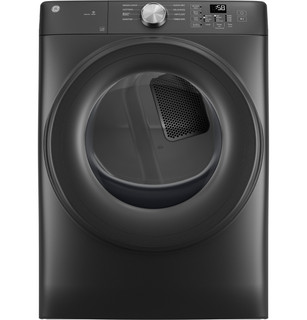
Specifications for GFD35ESPYDS with owner checks for this product design. Use the matching manual for control sequences and replacement parts.
Specifications & model details
GFD35ESPYDS: model-specific checks
Use the recorded energy source
GE GFD35ESPYDS is listed as Electric. Record power-on, tumbling and heat as three separate observations. Start a slow-drying check with the selected program, load and owner-accessible lint path. The supply rating and any burner or heating-circuit diagnosis require the original requirements for this model.
When heat is present but laundry stays wet, assess moisture evacuation, load movement, and cycle behavior in that order.
Owner guide: Heating but not drying
Category & symptom guidance
Heating but not drying
3 minute read · Shared guidance for clothes dryers
Make sure the load can tumble
A drum packed tightly with wet fabric can leave little room for air and movement, even when the dryer is producing heat. Remove some items and dry a smaller load of similar fabric. Shake out tangled sheets and separate thick garments from lightweight pieces so damp zones are not trapped against one another.
Check care labels before extending heat exposure. Some items should be dried on lower heat or laid flat, so a longer hot cycle is not an appropriate fix for every damp result.
Inspect the right moisture path
For a vented dryer, clear the lint screen and look at the visible exhaust duct for crushing, sharp bends, or a blocked exterior flap. Airflow carries water vapor outdoors; heat without adequate airflow can leave clothes damp and raise overheating risk. If the duct disappears behind the appliance, do not pull out a stacked unit or disconnect it yourself.
For a condenser or heat-pump design, check its water container and the user-accessible filters or heat exchanger described in its manual. These dryers do not use the same outdoor exhaust route. A full reservoir or neglected filter can impede moisture removal even while the machine feels warm.
Treat indicators as clues
A duct-clogging indicator on supported vented models signals an airflow concern, not the precise obstruction or a guaranteed appliance failure. Some LG DLEX4000/DLGX4001 family models list FlowSense; use the exact manual to interpret the display for your machine. If it appears after the screen is clean, the rest of the exhaust route may still need attention.
If no indicator is available, visible lint buildup, a weak exterior flap, or a cycle that has lengthened since vent work are useful observations. Do not probe the duct with tools or reach into an inaccessible outlet.
Check cycle and sensor conditions
A sensor cycle may end or revise time based on moisture readings; a very small load or mixed fabrics can make results less representative. Compare a moderate, similar-fabric load on a suitable cycle with the manual’s dryness choices. Timed drying can provide a comparison, but use a fabric-safe setting and do not keep extending cycles to compensate for suspected restricted airflow.
If garments are actually hot and damp, note whether all items share the symptom or only thick seams, pockets, and folded areas. That pattern helps distinguish uneven load drying from a broader moisture-removal issue.
Escalate when airflow checks do not resolve it
After one small comparison load and the applicable owner maintenance, persistent hot, damp laundry needs model-specific evaluation. Report the dryer design, fuel type, whether the drum tumbles, any indicator, and what was cleaned. A change after installation or vent rerouting is especially relevant.
If the cabinet is unusually hot, lint is accumulating around it, or there is a burning smell, stop using it. Do not open the dryer to inspect a heater or blower.
What to do with what you find
Smaller load dries, while a large mixed load stays damp.
Load volume or fabric distribution is contributing.
Use separated loads and avoid tightly packing the drum.
Hot damp clothes persist after design-specific filter and airflow care.
Moisture movement or dryer operation needs assessment.
Provide observations and indicator status to exact-model support.
Have these details ready
Dryer design and gas/electric type
Load size and fabric mix
Filter, reservoir, or vent checks completed
Indicator state and recent installation changes
Common questions
Does warmth prove the dryer’s airflow is adequate?
No. Heat and moisture evacuation are separate parts of drying.
Should I pull the dryer out to inspect its duct?
Not if it is heavy, stacked, or the duct is inaccessible. Arrange appropriate installation or service help.
General background sources
These sources support the shared guide. Exact model specifications and matched family procedures have their own sources above.