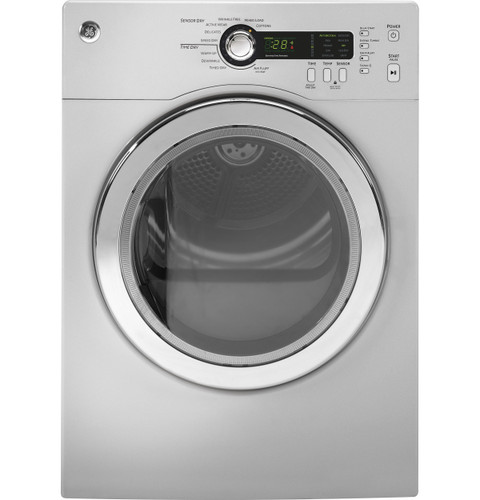
Specifications for DCVH485EKMS with owner checks for this product design. Use the matching manual for control sequences and replacement parts.
Specifications & model details
DCVH485EKMS: model-specific checks
Plan with this model’s measurements
For GE DCVH485EKMS, the source gives width 23.5 in (596.9 mm), height 33.375 in (847.7 mm), depth 25.6875 in (652.5 mm). Measure the narrowest doorway, turning space and final opening using those same directions. These are product measurements; add the separately specified hose, ventilation, door/lid, handle and service space. The reported width × depth occupies about 4.19 square feet before those allowances.
GE DCVH485EKMS is listed as Electricity. Record power-on, tumbling and heat as three separate observations. Start a slow-drying check with the selected program, load and owner-accessible lint path. The supply rating and any burner or heating-circuit diagnosis require the original requirements for this model.
Prepare the location by confirming dryer type, utilities, exhaust or condensation handling, clearances, delivery access, and any model-specific accessories.
Owner guide: Installation planning
Category & symptom guidance
Installation planning
4 minute read · Shared guidance for clothes dryers
Identify what the home and dryer require
Before delivery, establish the dryer’s exact model and whether it is gas or electric. Then compare its installation instructions with the utilities actually present: electrical supply, gas connection where applicable, and the exhaust or condensate arrangement required by the design. A similar cabinet or product-family name does not establish that the connections match.
Dryers may be vented, condenser, or heat-pump designs. A vented unit sends moist air through an exhaust duct; condenser and heat-pump units manage moisture differently and may need a drain or collection arrangement specified by their instructions. Do not plan a new unit around an existing vent opening until the selected dryer type is known.
Prepare a vented-dryer exhaust route
For a vented dryer, inspect where the duct begins, where it exits outdoors, and whether the route is accessible for cleaning. Confirm the exact model’s permitted duct material, diameter, length, bends, and outlet requirements in its installation guide. Keep the route as direct as the instructions allow and avoid a plan that leaves the connector crushed when the dryer is moved into place.
Some models permit more than one exhaust direction, often with a specific kit. Verify kit compatibility and the resulting spacing before cutting or altering cabinetry. Do not discharge dryer exhaust into a wall, attic, crawlspace, or room. If the existing route is damaged, obstructed, or ends indoors, arrange correction before normal use.
Plan gas or electric connections correctly
An electric dryer needs the supply and cord arrangement specified for its exact model and jurisdiction. A gas dryer also needs the correct electrical supply, plus a suitable gas connection; its small electrical rating does not eliminate the fuel requirement. Do not adapt a plug, change wiring, or connect gas based on a family brochure. Confirm the site and installation plan with the installer before the appliance arrives.
If a gas model is being converted for a different fuel, verify whether the manufacturer lists a conversion procedure and the exact kit for that model. A kit listed for one family is not universal, and conversion is not an owner improvisation. Make sure the installer knows the fuel available and the model code before work begins.
Check the site and delivery details
Measure the delivery route and final location, including door swing, overhead space, wall projections, and room for utility connections. Remove loose items from the route and identify any fragile flooring or narrow turn before delivery. Tell the retailer if the dryer will be stacked, placed on a pedestal, or routed through a tight opening so the delivery plan can account for the configuration.
For a closet, follow the exact model’s opening and ventilation requirements. Some manufacturer instructions specify upper and lower air openings; do not substitute a closed door or assume a louvered panel meets the area requirement without checking. Keep access for lint-filter removal and future service in the layout.
Complete setup checks before routine use
After placement, the installer should verify leveling, stable footing, utility connections, exhaust attachment for vented designs, and that no cord or duct is pinched. Review the owner instructions for first-use checks and controls. If the model has an installation-check feature, use it only as directed in that model’s manual; a feature described on another model’s sheet is not evidence yours includes it.
For condenser or heat-pump designs, confirm that the condensate container or drain is set up as instructed and that filters and heat-exchanger access remain clear. Do not apply vented-dryer airflow assumptions to these machines. Keep the completed installation information and any conversion or accessory details with the appliance record.
What to do with what you find
The utility and exhaust or moisture-handling plan matches the exact dryer instructions.
The site is prepared for the selected design and fuel type.
Confirm delivery access, accessories, and installer scope.
The home connection is uncertain, or a vented unit’s route ends indoors or is obstructed.
The appliance should not be put into routine service under the current plan.
Resolve the connection or duct route before installation.
Have these details ready
Full dryer model code and installation instructions
Site utility details and fuel available
Exhaust route or condensate arrangement, depending on dryer design
Delivery route and final-space measurements
Common questions
Can I reuse the old dryer vent for any new dryer?
Only if the selected dryer is vented and the route meets its instructions, is intact, and terminates outdoors.
Does a gas dryer need an electrical connection?
Yes. It needs the electrical supply specified for that model as well as its gas connection.
General background sources
These sources support the shared guide. Exact model specifications and matched family procedures have their own sources above.