Confirm the plug is seated if safely accessible, the outlet works with another small appliance, and the refrigerator has not been switched off at its control. If the breaker trips again, the cord or outlet is hot, or there is an electrical odor, stop and use an electrician or qualified appliance technician. Record whether lights, display, and cooling all stopped together. The manual documents control operation, not energized electrical diagnosis.
Check household power and controls first
Confirm the plug is seated if safely accessible, the outlet works with another small appliance, and the refrigerator has not been switched off at its control. If the breaker trips again, the cord or outlet is hot, or there is an electrical odor, stop and use an electrician or qualified appliance technician. Record whether lights, display, and cooling all stopped together.
The manual documents control operation, not energized electrical diagnosis.
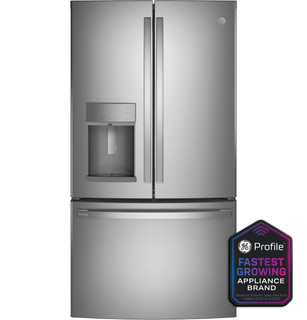
GE Profile PFE28KYNFS is listed with Frost Guard defrost. Use the branch for the listed defrost system. Note whether frost is confined to a door edge, covers stored packages, or returns on an interior surface. Door closure, moisture entry and a defrost-system problem produce different patterns.
Use visible signs to distinguish a refrigerator with no apparent power from one whose controls are unresponsive. Check accessible household power safely and stop if wiring is damaged.
Owner guide: No power & starting
Category & symptom guidance
No power & starting
5 minute read · Shared guidance for refrigerators
Tell a dark refrigerator from an unresponsive control
Observe the appliance before touching any controls. Note whether the interior light comes on when the door opens, whether the display is dark, and whether you can hear normal operation. A dark display with an interior light suggests the appliance may have power while its display or controls are not responding. No interior light and no sound leave the outlet, plug, household circuit, or appliance as possibilities. Some models have different light and display behavior, so use the owner manual for the specific model rather than assuming one indicator proves the whole refrigerator is powered. Check the model label if it is safely visible. Do not repeatedly press buttons, unplug and reconnect the unit in cycles, or remove a control cover to investigate.
Record which lights, display areas, and sounds are present.
Check the model’s owner instructions for expected indicators.
Leave covers and wiring untouched.
Inspect the plug and cord from a safe position
If the refrigerator is accessible without shifting it, look at the plug and the visible length of the cord. A plug that appears partly out of the receptacle may explain a no-power condition, but do not touch it if the area is wet, hot, sparking, or damaged. Look for a crushed, cut, frayed, or discolored cord without pulling the appliance forward. A cord that disappears behind the refrigerator is not an invitation to move a heavy unit or reach into a narrow gap. If there is a burning odor, buzzing, visible damage, or heat at the plug, stop and keep others away. A qualified electrician or appliance servicer can assess the circuit or appliance safely.
Look only at plug and cord sections plainly visible from the room.
Do not touch damaged, wet, hot, or sparking electrical parts.
Arrange service if the connection appears compromised.
Check the household outlet without improvising
When the outlet is accessible and dry, you can check whether it supplies power with a known-safe device that is appropriate for that outlet, such as a working lamp. Use the device only if its plug fits normally and the outlet shows no damage. If the device also does not work there, the issue may be with the outlet or household circuit rather than the refrigerator. If it works, the refrigerator or its connection remains a possibility; the test does not establish which internal component is at fault. Do not use exposed wires, adapters, extension cords, or improvised testers. Do not unplug a heavy refrigerator by pulling the cord. If reaching the receptacle requires moving the unit or contacting a questionable plug, skip the check and call for help.
Use a known-safe device only at a dry, accessible outlet.
Note whether the device works at that receptacle.
Do not move the refrigerator or improvise a test.
Consider the household breaker only if accessible
If the outlet seems dead and the breaker panel is readily accessible, look for a breaker that is visibly tripped. Follow the panel’s instructions and household safety practices. A breaker that trips again after a reset, or one that feels hot, smells unusual, or shows damage, needs an electrician; do not continue resetting it. If the refrigerator shares a circuit with other appliances, note what else stopped working. This can help an electrician identify whether the problem follows the circuit. Never remove the panel cover or work inside the electrical panel. If the breaker is not clearly identified or you are unsure how to operate it safely, leave it alone and arrange qualified assistance.
Check only a plainly accessible household breaker.
Record any other outlets or appliances affected.
Stop if the breaker trips again or shows heat, odor, or damage.
Choose the next step from the evidence
If the outlet test device works and the plug and cord look intact, yet the refrigerator has no light, display, or sound, contact the manufacturer or a qualified appliance servicer. Provide the model and serial number, indicator observations, and any recent outage or electrical event. If the display is dark but interior lighting or operation is present, report that exact split rather than calling the entire unit powerless. A known dead outlet or repeatedly tripping breaker points toward household electrical help. Do not cycle power repeatedly in an attempt to force a restart; that can obscure the original symptom and is not a diagnosis. Keep food safety in mind during an extended outage and use a refrigerator thermometer or food safety guidance to decide what can be kept.
Share the observed lights, sounds, outlet result, and breaker status with the right service provider.
Avoid repeated power cycling.
Protect perishable food during an extended loss of cooling.
What to do with what you find
Interior light, display, and sound are all absent, and the safe outlet test device also fails.
The receptacle or household circuit may be without power.
Check an accessible breaker once according to household practice or contact an electrician.
The outlet test device works and the visible plug and cord appear intact, but the refrigerator remains dark and silent.
A refrigerator-side fault remains possible and is not identifiable by external checks.
Contact the manufacturer or a qualified appliance servicer with model and symptom details.
The breaker trips again, or the plug/cord is hot, damaged, or sparking.
The circuit or connection may be unsafe to operate.
Stop resetting or touching it and seek qualified electrical help.
Have these details ready
Model and serial number if safely accessible
Interior light, display, and sound observations
Known-safe outlet test result and any accessible breaker behavior
Recent outage or other affected household outlets/appliances
Common questions
If the display is blank, is the refrigerator definitely off?
No. Interior lighting or operation may still be present. Record each indicator separately and consult the model’s owner instructions.
Should I unplug it and plug it back in several times?
No. Repeated cycling is not a useful external check and can obscure the symptom. Document what you see and contact service.
General background sources
These sources support the shared guide. Exact model specifications and matched family procedures have their own sources above.
Printed page19, PDF page10, PFE28KYN product block and option footnote
Catalog explicitly names the three finish variants. Options are separately sold; this does not establish installed accessories, current availability or individual manufacture date.
Printed page19, PDF page10, PFE28KYN product block and option footnote
Catalog explicitly names the three finish variants. Options are separately sold; this does not establish installed accessories, current availability or individual manufacture date.