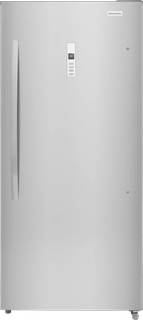
Guidance for Frigidaire refrigerators. Check the feature and control descriptions against your model.
Specifications & model details
FFUV2136AV: model-specific checks
Plan with this model’s measurements
For Frigidaire FFUV2136AV, the source gives width 29.7 in (754.4 mm), height 66.6 in (1,691.6 mm). Measure the narrowest doorway, turning space and final opening using those same directions. These are product measurements; add the separately specified hose, ventilation, door/lid, handle and service space.
Frigidaire FFUV2136AV is listed at 306 kWh/year. Using an illustrative $0.20/kWh, that is $61.20 per year, or $5.10 per month, on the source’s annual test basis. For your rate, multiply 306 by your electricity price per kWh. Compare labels from the same test method; age, actual use, water heating and load choices can change the household result.
Frigidaire FFUV2136AV is listed with Automatic defrost. Use the branch for the listed defrost system. Note whether frost is confined to a door edge, covers stored packages, or returns on an interior surface. Door closure, moisture entry and a defrost-system problem produce different patterns.
Read a refrigerator listing by separating its published specifications from your own assessment of layout, operating cost, fit, features and support.
Owner guide: Specification review
Category & symptom guidance
Specification review
5 minute read · Shared guidance for refrigerators
Start with the space the refrigerator must serve
A listing can be accurate and still describe a poor choice for your kitchen. Begin by writing down the opening width, height and depth you have measured, plus the space needed for doors and drawers to open. Then compare those observations with the manufacturer’s installation drawing for the exact model and configuration. Do not infer fit from a product photo or from another refrigerator in the same family. Listings sometimes summarize dimensions without showing how handles, hinges, water connections or door projection affect placement. Record each published dimension and the drawing location where you checked it. Your evaluation can then say, for example, that the stated cabinet depth appears workable while the drawing shows a door projection that may limit the nearby walkway. That is a useful, checkable trade-off, rather than a vague claim that the appliance is compact.
Measure the opening and approach route yourself; keep the measurements with their locations.
Find the exact model’s installation drawing and compare its stated dimensions, door projection and required opening space.
Mark any dimension or clearance that the listing does not establish as unverified.
Judge capacity through the actual layout
Published capacity is a specification, not a promise that every shelf will suit your groceries. Note the refrigerator and freezer capacities separately when available, then inspect the interior images or layout diagram for shelf width, bins, drawers and obstructions. Think about the containers you regularly store: a wide platter, tall bottles, frozen packages or produce bags. If the listing does not publish a usable shelf dimension, do not make one up from a photograph. Describe what the diagram supports and what remains uncertain. A large total capacity may still be inconvenient if the layout divides space in ways that conflict with your routine. Conversely, a smaller stated capacity can be adequate when shelves and bins match what you store. Keep your assessment grounded in the configuration shown for the exact model, not a similar model with different doors or compartments.
Record refrigerator and freezer capacities as separate published figures.
Match visible shelves, bins and drawers to several items you actually store.
Write down any usability question the listing and drawing cannot answer.
Separate energy facts from cost estimates
Use the energy information for the exact listing and compare like with like. The U.S. Department of Energy’s FEMP guidance explains how efficiency, capacity and energy labels can support refrigerator purchase comparisons. Record the published annual energy use and the label or source that reports it. If you want an annual cost estimate, multiply that annual energy figure by your electricity price per kilowatt-hour; state the rate and calculation so a reader can reproduce it. Your local rate may differ from any estimate displayed by a seller. Avoid treating a lower annual cost as a complete verdict: capacity, layout and fit still matter. Also avoid comparing figures from different sizes or configurations as if they had the same basis. A meaningful review says what the label reports, what assumptions were used to estimate cost, and whether the difference changes your decision.
Capture annual energy use from the exact model’s applicable label or listing.
For a cost estimate, multiply annual use by your own electricity rate and state the rate.
Compare models with similar capacity and configuration, and keep the published energy figure distinct from your estimate.
Evaluate features by the job they do
List features only when the listing identifies them for the exact configuration. For water and ice, establish whether the model has a dispenser, an ice maker, both or neither, and check what the listing says about water connection requirements. For adjustable shelving or specialty drawers, ask whether the feature solves a real storage need. Do not assume a feature is included because a product-family page shows it; sellers may group configurations together. A feature can also add a trade-off: a dispenser may take interior space, while a desired layout may be available only in another finish or configuration. Explain the practical consequence rather than repeating marketing language. If a feature’s operation, included accessory or connection requirement is not stated, label it as a question for the seller or manufacturer instead of filling the gap with a guess.
Verify each desired feature against the exact model identifier and configuration.
Check listed water connection and accessory requirements before treating a feature as ready to use.
Connect each feature to a specific household need and note its documented trade-off.
Check support and make a balanced conclusion
A useful review closes with support facts and unresolved questions. Find the warranty terms for the exact purchase and distinguish coverage duration, covered parts or labor, and any conditions stated in the document. Confirm who handles service in your area; a brand support page is relevant to that brand’s products, not proof that a seller or third party is authorized for every make. The GE refrigerator support page, for example, is appropriate when evaluating GE support options. State what the source actually confirms. Then weigh your findings: perhaps the layout suits your storage, the energy figure is attractive at your rate, but the installation drawing leaves a door-swing question. That is a defensible conclusion. Avoid calling a product “best” without stating the household needs and evidence behind the judgment, and do not invent customer experiences or present specifications as reviews.
Read warranty terms and record who provides service and how to contact them.
Match any support claim to the manufacturer or provider named in the source.
Summarize the strongest fit and the most consequential unresolved issue without claiming personal or customer experience.
What to do with what you find
The exact model’s installation drawing dimensions and door projection fit the measured opening and nearby passage.
The available published geometry supports a likely fit, though delivery-route constraints may still need checking.
Compare the refrigerator’s packaged and unpackaged dimensions with the full delivery route before ordering.
Annual energy-use figures differ, but the models have substantially different capacities or configurations.
The raw figures are not a fair efficiency comparison for the purchase you are considering.
Use FEMP guidance and compare appropriate capacity and configuration information before estimating relative operating cost.
The listing shows an ice or water feature but does not identify connection requirements for the exact configuration.
The feature’s presence does not establish that it can be installed as planned.
Ask the seller or manufacturer for the exact model’s requirements and verify the kitchen connection.
Have these details ready
Exact model identifier and configuration
Manufacturer installation drawing and listing specifications
Applicable energy label or annual energy-use figure
Warranty terms and support provider details
Common questions
Can a review call a refrigerator energy-efficient based only on its advertised annual cost?
It should identify the underlying annual energy figure and the assumptions behind any cost estimate. Electricity rates vary, so calculate using your own rate and compare models on a similar basis.
Should I use a product-family page to confirm a feature?
Only if it identifies the exact model and configuration. Otherwise, confirm the feature with the exact model listing, drawing or manufacturer.
General background sources
These sources support the shared guide. Exact model specifications and matched family procedures have their own sources above.
refrigerators.csv; row 733; ENERGY STAR ID 4519348
Certification dataset declaration; check manufacturer installation documents for fit and clearances.
Observed Oct 31, 2026
A comparison group built from recorded designs
Frigidaire refrigerators
17 records in this manufacturer/public-source group. The group uses the brand, category and recorded design, rather than a guessed series or production year.
261.0–306.0 kWh/yearannual energy · 17 source values
27.7–32.8 inwidth · 17 source values
61.8–71.0 inheight · 17 source values
These are source-record ranges. They do not establish current availability, a shared repair platform or installation compatibility.
Put the source facts side by side
FFUV2136AV has 11 recorded specification fields. Compare the fields that matter for your space and use, then resolve gaps with the original documents. These are catalog candidates; fit, availability, and successor relationships have not been established.