Record temperature and recovery time before estimating repair
Frigidaire recommends a stabilization window of about 24 hours after setup or adjustment. Note the ambient temperature, actual cabinet temperature, load and door openings over that period; these distinguish recovery from persistent cooling trouble.
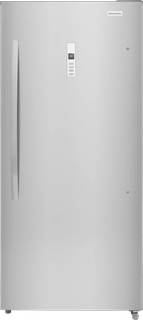
Frigidaire FFUV2136AV is listed at 493 kWh/year. Using an illustrative $0.20/kWh, that is $98.60 per year, or $8.22 per month, on the source’s annual test basis. For your rate, multiply 493 by your electricity price per kWh. Compare labels from the same test method; age, actual use, water heating and load choices can change the household result.
Compare a documented repair plan with the full cost and fit of a replacement, using the exact model and your storage needs rather than age or a single symptom alone.
Owner guide: Repair or replace?
Category & symptom guidance
Repair or replace?
3 minute read · Shared guidance for freezers
Start with the appliance identity and evidence
Read the complete model number from the rating label and locate its owner manual. Chest and upright designs differ in access, installation footprint, and some maintenance; manual-defrost and frost-free units also have different care needs. Do not carry a control setting, drain procedure, or clearance from one model to another. The GE and Danby support pages provide model-specific routes to manuals and service information.
Describe the problem with measurable facts: freezer temperature, when it changed, whether the lid or door closes, visible frost or water, and any indicator or sound. A control dial number alone does not tell you the internal temperature. Use a thermometer and keep food safety decisions separate: FoodSafety.gov's target is 0°F or below, with separate outage guidance for food disposition.
Photograph the model label and find the matching manual through the maker's support page.
Record measured temperature and observable symptoms before discussing repair.
Get a repair recommendation you can evaluate
Ask the technician what was tested, what fault those tests indicate, which work is proposed, and whether further diagnosis may be needed. Request a written estimate that separates parts, labor, visit charges, taxes, and follow-up. Ask about the part and repair warranty and how the provider will handle the freezer if the repair does not restore operation.
Manufacturer troubleshooting pages can suggest external checks and direct owners to service, but they do not prove a component has failed. A light that works, a warm cabinet, or an unfamiliar sound is not enough to name an internal part. Avoid internal electrical or sealed-system work yourself.
Ask for the diagnosis and estimate in writing, with any uncertainty or additional visit cost stated.
Compare the proposed work with a second estimate if the fault or scope is unclear.
Compare full costs and consequences
For repair, total the diagnostic charge, approved work, likely follow-up, and any lost-food or temporary-storage expense you actually face. For replacement, include the unit price, delivery, removal, installation, electrical or access work, and any disposal charge. Use estimates for your situation; a broad rule based on appliance age or a fixed percentage cannot account for model, parts availability, or local labor.
Compare operating energy from the replacement's product information with the current unit only where you have a defensible comparison. ENERGY STAR provides freezer specifications and energy-use comparisons, not a promise that replacing a working unit will repay its purchase cost.
Check replacement fit and features
Measure the available width, height, depth, doorway route, and space for the lid or door to open. Check the candidate model's installation manual for required ventilation clearance; do not reuse clearance numbers from a different freezer. Choose capacity and layout around what you store and how often you access it. Chest freezers and uprights have different footprints and access patterns, while frost-free operation and manual defrost are distinct feature choices.
Verify optional features on the exact model listing or manual: alarms, fast-freeze, locks, or connectivity are not standard on every freezer. Compare full model identifiers and delivered terms, since similarly named units can differ in features.
Measure the cavity and delivery path, including room for opening the lid or door.
Check the exact model's manual and specification sheet for clearances, defrost design, dimensions, and features.
Plan service, warranty, and disposal
Check the current warranty for the exact model and purchase date before authorizing paid work. Manufacturer support pages can route you to service and parts, but warranty coverage depends on the applicable terms and proof of purchase. Search the exact manufacturer and model on the CPSC recall site and follow any notice instructions; a search should not be treated as evidence that no recall exists.
If replacing, check utility rebates and local collection or retailer take-back rules. EPA guidance explains responsible appliance disposal and refrigerant recovery. Keep the label and purchase records until the old unit is removed and any service, warranty, or rebate matter is resolved.
General background sources
These sources support the shared guide. Exact model specifications and matched family procedures have their own sources above.
Certification dataset declaration; check manufacturer installation documents for fit and clearances.
Observed Oct 31, 2026
A comparison group built from recorded designs
Frigidaire upright freezers
14 records in this manufacturer/public-source group. The group uses the brand, category and recorded design, rather than a guessed series or production year.
380.0–493.0 kWh/yearannual energy · 14 source values
13.0–21.1 cu ftcapacity · 14 source values
These are source-record ranges. They do not establish current availability, a shared repair platform or installation compatibility.