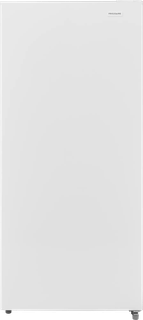
Guidance for Frigidaire freezers. Check the feature and control descriptions against your model.
Specifications & model details
FFUV2126AW: model-specific checks
What this model’s energy figure means
Frigidaire FFUV2126AW is listed at 493 kWh/year. Using an illustrative $0.20/kWh, that is $98.60 per year, or $8.22 per month, on the source’s annual test basis. For your rate, multiply 493 by your electricity price per kWh. Compare labels from the same test method; age, actual use, water heating and load choices can change the household result.
Frigidaire FFUV2126AW is listed with Automatic defrost. Use the branch for the listed defrost system. Note whether frost is confined to a door edge, covers stored packages, or returns on an interior surface. Door closure, moisture entry and a defrost-system problem produce different patterns.
Frigidaire FFUV2126AW is recorded as upright. Check the door swing, shelf or drawer seating, and packages projecting into the seal. For uneven cooling, keep the source-listed defrost design in view: airflow checks apply to a fan-cooled layout, while a manual-defrost layout has its own unloading and defrost procedure.
Compare freezers by exact model, matching energy data, installation fit, and features that matter in your space. Verify every difference in the candidate’s own documentation.
Owner guide: Compare similar models
Category & symptom guidance
Compare similar models
3 minute read · Shared guidance for freezers
Choose a fair comparison set
Select models that can serve the same job: similar storage needs, installation location, and access pattern. Record each complete model code because small suffix changes may indicate different configurations. Use official support pages to identify manuals and specifications, then check that each document names the exact model.
Create a side-by-side list with capacity, external dimensions, defrost type, controls, electrical requirements, and listed options. Mark missing information as unknown and ask the manufacturer or seller to confirm it. A feature on one model should not be presumed to exist on its close relative.
Write down full identifiers for every candidate.
Collect each exact manual, specification page, and energy figure before comparing.
Compare access and defrost work
A chest freezer often loses less cold air when opened because its opening is at the top, but retrieving items from the bottom can take more effort. An upright can make contents easier to see and reach, while its door opening and shelving require adequate space. Choose based on the way the household loads and retrieves food.
Distinguish manual defrost from frost-free operation using the exact product documentation. Manual-defrost units require the owner to remove frost according to the model’s instructions; timing and drain arrangements vary. Do not apply one model’s defrost threshold or method to another.
Compare energy on matching data
Use ENERGY STAR freezer listings and each candidate’s published annual energy figure to compare energy consumption on a consistent basis. Record the annual kWh value for each exact candidate and note the source and date. A standardized figure supports comparison, but actual consumption changes with room temperature, loading, door opening, and other use conditions.
Estimate annual electricity cost by multiplying annual kWh by your electricity rate. Apply the same method and rate to all candidates, then add purchase, delivery, and any installation or removal charges. Avoid treating an old label or a generic estimate as your current household bill.
Use one electricity rate and one calculation for all models.
Keep energy use and annual cost in separate columns so assumptions remain visible.
Compare fit and documented features
Measure the installation location and delivery route, including turns, door swing, stairs, and overhead lid movement. Check each model’s own manual for required clearance and electrical details. A published dimension without door or lid movement may not describe the space needed to use the appliance comfortably.
Record only features explicitly listed for the exact code: lock, alarm, power indicator, fast-freeze control, baskets, interior light, or drain. For example, the Danby DUFM085A2BSLDD guide lists model-specific clearances of 4 inches at the rear, 8 inches at the sides, and 12 inches at the top; that example does not set spacing for other models.
Sketch the space with measured dimensions and outlet position.
Check each candidate’s installation diagram and feature list.
Compare total ownership terms
Compare current purchase price with delivery, haul-away, return, and service terms. Verify whether the seller has the exact model in stock and whether quoted bundles or promotions change the delivered total. FTC shopping guidance recommends checking seller information and the terms of an online transaction; keep a copy of the listing and order terms.
Check warranty coverage and parts or service lookup using each exact model identifier. A specification comparison cannot establish reliability or remaining service life. A useful final choice reflects documented fit, storage, energy, maintenance, support, and total cost against the way the freezer will actually be used.
General background sources
These sources support the shared guide. Exact model specifications and matched family procedures have their own sources above.
Certification dataset declaration; check manufacturer installation documents for fit and clearances.
Observed Oct 31, 2026
A comparison group built from recorded designs
Frigidaire upright freezers
14 records in this manufacturer/public-source group. The group uses the brand, category and recorded design, rather than a guessed series or production year.
380.0–493.0 kWh/yearannual energy · 14 source values
13.0–21.1 cu ftcapacity · 14 source values
These are source-record ranges. They do not establish current availability, a shared repair platform or installation compatibility.
Put the source facts side by side
FFUV2126AW has 9 recorded specification fields. Compare the fields that matter for your space and use, then resolve gaps with the original documents. These are catalog candidates; fit, availability, and successor relationships have not been established.