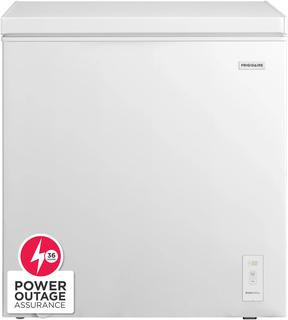
Specifications for FFCS0762AW with owner checks for this product design. Use the matching manual for control sequences and replacement parts.
Specifications & model details
FFCS0762AW: model-specific checks
Choose the recorded defrost branch
Frigidaire FFCS0762AW is listed with Manual defrost. Use the manual-defrost branch below: plan cold storage for the food before melting accumulated ice, protect the floor, and use the documented drain arrangement. Keep sharp tools and direct heat away from the liner and refrigerant path.
Prepare a freezer for an absence or seasonal shutdown by protecting food, cleaning and drying the cabinet, and following the exact manual for restart or relocation.
Owner guide: Storage & seasonal care
Category & symptom guidance
Storage & seasonal care
3 minute read · Shared guidance for freezers
Decide whether the freezer will stay powered
For a short absence, keeping a freezer operating is usually the simplest option when the home’s power remains reliable. Confirm the door or lid closes, the gasket is clear, and the interior is not so tightly packed that it blocks designed airflow. Use a thermometer to verify the food compartment is at or below 0°F; the control dial alone does not confirm temperature.
For a planned outage or long shutdown, move food to another working freezer if available. FoodSafety.gov advises keeping the freezer closed during a power outage and gives approximate closed-door holding times of 48 hours when full and 24 hours when half full. Those are emergency food guidance, not guarantees of appliance performance or permission to keep food after a particular event.
Handle food by its temperature and exposure
During an outage, minimize openings and keep a thermometer with the food if possible. FoodSafety.gov says food may be safely refrozen if it still contains ice crystals or is at 40°F or below; use the agency’s food-specific chart for items that have warmed beyond that point. Never taste food to decide whether it is safe, and do not use the appliance’s alarm or indicator as a substitute for measuring food conditions.
If food is transferred for seasonal storage, keep packages sealed and labeled so thawing or leakage does not contaminate other items. When restarting, do not reload vulnerable food until a thermometer confirms the freezer has returned to a suitable temperature.
Keep the door closed during an outage and check food conditions with a thermometer.
Use the FoodSafety.gov charts to decide whether each affected food can be kept, refrozen, or discarded.
Prepare an empty freezer for storage
If the appliance will be unused, remove all food, unplug it, and clean the interior using the model’s instructions. For manual-defrost models, defrost only as directed and remove water through the drain arrangement provided for that model. Dry the liner, gasket, baskets, and drain area completely so standing moisture does not remain in corners.
Prevent an empty freezer from being closed around a child or animal. Keep it secured and ventilated as its manual directs; do not improvise a latch or prop that could damage the hinge or seal. The cited Danby guides include unit-specific vacation, cleaning, and moving instructions, so consult the exact model before choosing storage position or handling the cord and door.
Remove food and accessories that the manual says may be removed.
Unplug, clean, and dry the cabinet; manage the door as the owner’s manual directs for an empty unit.
Move the freezer with model instructions
Before moving, empty and unplug the freezer, secure loose shelves or baskets, and protect the cord and door from damage. Use enough people and suitable moving equipment for the appliance’s weight; avoid lifting by a handle or other part unless the manual identifies it as a lifting point. Keep the unit upright when practical and follow the manufacturer’s instructions if it must be tilted.
After placement, restore the specified clearances and level the appliance. Do not plug in immediately if it was tilted or laid down: the wait time is model-specific and should come from the owner’s manual or manufacturer support. The available sources do not establish one universal settling interval, so do not borrow a wait time from another brand or model.
Restart and verify before restocking
Use the manual’s control instructions after storage. A setting number is not a temperature, and a high or fast-freeze setting is temporary only where the exact appliance provides that feature and its instructions call for it. Allow the freezer to cool, then verify with a thermometer placed among packages before relying on it to protect food.
If the freezer was without power, separate food-safety decisions from appliance troubleshooting. FoodSafety.gov determines what food may be kept; the owner’s manual and manufacturer support guide restarting, alarms, and operating checks.
Reconnect only after the appliance is dry, correctly positioned, and ready according to its manual.
Measure the internal temperature before replacing food that needs continuous freezing.
General background sources
These sources support the shared guide. Exact model specifications and matched family procedures have their own sources above.