What is recorded for FFBD2420UW
Frigidaire FFBD2420UW — Product type: Standard.
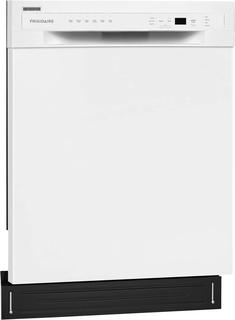
Frigidaire FFBD2420UW
Dishwasher · US market · 48 owner topics
Guidance for Frigidaire dishwashers. Check the feature and control descriptions against your model.
Specifications & model details
Frigidaire FFBD2420UW — Product type: Standard.
Frigidaire FFBD2420UW lists Heated Dry for drying. Evaluate the result after the selected program finishes, considering rinse-aid instructions, load arrangement and plastics. Do not transfer a heated-dry, door-opening or fan-dry setting from another Frigidaire model.
Use the sound’s timing and location to separate normal water movement from loading contact, installation vibration, or a condition that needs attention.
Category & symptom guidance
Listen from outside the closed machine and note whether the sound occurs during filling, spray, draining, or after the cycle. A swish or changing spray sound can track water reaching different surfaces; a hum may coincide with pumping. The useful clue is not simply loudness but whether the noise repeats at one stage and whether cleaning results or drainage changed at the same time.
Record a short description such as “plastic tapping during wash” or “rattle only while draining.” Avoid placing a hand inside or opening the door during active spray. If opening the door pauses operation on your model, wait for the spray and moving parts to stop before inspecting the load.
A common owner-check is whether a pan handle, utensil, or dish extends into the path of a spray arm. The GE shared manual warns that items protruding through the rack bottom can block arm rotation and cause noise or poor washing; tall dishes can also strike a middle arm. Rack shapes differ, so rotate each accessible arm gently by hand only when the machine is off and empty enough to reach it safely. It should move without hitting dishes or rack parts.
Rearrange the load so plates sit securely between tines and long utensils lie in a location that cannot reach the arm or door seal. Check that the detergent dispenser is not blocked by a large dish. If the noise disappears with a revised load, the contact was likely the cause; if not, retain the same sound notes for further diagnosis.
A rattle that changes when the load changes often comes from dishes or utensils touching one another. Separate nested spoons and keep glassware from knocking together. A sound that persists with a small, balanced load may instead come from the machine or surrounding cabinetry. Look from the room side for an obvious loose object against the door or adjacent cabinet; do not remove panels or reach behind the appliance.
Installation can affect vibration: an appliance that rocks, rubs cabinetry, or shifts when the door opens may need its leveling or mounting checked. Those adjustments are installation-specific. If it is newly installed, compare the symptom with the installer’s documentation and have the installation checked rather than forcing the unit into place.
A louder-than-usual drain sound together with water left in the tub is more informative than a sound alone. Accessible checks may include a visibly obstructed filter or an air gap, if installed, but layouts and cleaning directions vary. The GE manual describes checking its air gap when draining poorly and cleaning it with the appliance off; that instruction is not a universal filter-removal procedure.
A harsh grinding, repeated knocking that does not change with the load, or a new sound accompanied by a leak or cycle stoppage warrants stopping use. Note whether water remains, whether dishes are still being washed, and whether the sound began after installation or a change in loading. These details help narrow the cause without unsafe disassembly.
Load contact or spray-arm interference is likely.
The source may be in the appliance or installation rather than dish contact.
No. Water movement and pumping can make changing sounds during a cycle. A new persistent sound, especially with poor cleaning, standing water, or leaking, needs closer attention.
Only when the machine is off and you can reach it without force. Remove obvious dish contact and ensure nothing blocks its path before starting again.
These sources support the shared guide. Exact model specifications and matched family procedures have their own sources above.
Owner guidance by Specs & Parts, drafted with GPT-6 Luna. Sources and scope.
Recorded model facts
| Specification | Recorded value | Evidence |
|---|---|---|
| Maximum place settings | 8 | CertificationENERGY STAR — Dishwashers dishwashers.csv; row 272; ENERGY STAR ID 2453144 Certification dataset declaration; check manufacturer installation documents for fit and clearances. Observed Oct 31, 2026 |
| Connected capability | No | CertificationENERGY STAR — Dishwashers dishwashers.csv; row 272; ENERGY STAR ID 2453144 Certification dataset declaration; check manufacturer installation documents for fit and clearances. Observed Oct 31, 2026 |
| Drying method | Heated Dry | CertificationENERGY STAR — Dishwashers dishwashers.csv; row 272; ENERGY STAR ID 2453144 Certification dataset declaration; check manufacturer installation documents for fit and clearances. Observed Oct 31, 2026 |
| Listed features | Self-Cleaning Filter | CertificationENERGY STAR — Dishwashers dishwashers.csv; row 272; ENERGY STAR ID 2453144 Certification dataset declaration; check manufacturer installation documents for fit and clearances. Observed Oct 31, 2026 |
| Soil-sensing capability | Yes | CertificationENERGY STAR — Dishwashers dishwashers.csv; row 272; ENERGY STAR ID 2453144 Certification dataset declaration; check manufacturer installation documents for fit and clearances. Observed Oct 31, 2026 |
| Product type | Standard | CertificationENERGY STAR — Dishwashers dishwashers.csv; row 272; ENERGY STAR ID 2453144 Certification dataset declaration; check manufacturer installation documents for fit and clearances. Observed Oct 31, 2026 |
| Tub material | Stainless Steel | CertificationENERGY STAR — Dishwashers dishwashers.csv; row 272; ENERGY STAR ID 2453144 Certification dataset declaration; check manufacturer installation documents for fit and clearances. Observed Oct 31, 2026 |