Appliance & electronics support
Find your model numberAbout our sources
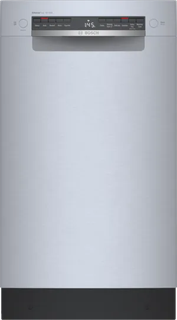
Bosch SPE53C55UC product photo
Photo: SPE53C55UC. Photo source
Manufacturer sources

Bosch SPE53C55UC

Cycles & programs

Dishwasher · US market · 47 owner topics

Bosch dishwashers

Guidance for Bosch dishwashers. Check the feature and control descriptions against your model.

Bosch dishwashers

Bosch drying: identify the system before changing the load or cycle

Bosch describes a condensation-based drying core across its current top-control dishwasher line. On that line, PureDry is standard; AutoAir appears on select 500 Series models and opens the door to vent moisture; CrystalDry appears on select 800 Series and Benchmark models and converts moisture into heat up to 176°F. “Select” matters: series name alone does not prove the installed feature. Identify the E-Nr and confirm the option on its Bosch product page or manual before attributing a drying result to AutoAir or CrystalDry.

Start with where water remains. Bosch’s condensation account says the stainless tub cools after the hot final rinse, so moisture condenses on the tub walls and drains; rinse aid helps water sheet off dish surfaces. Droplets on the tub wall therefore do not alone show a leak or heater failure. Check spacing and rinse aid first, then compare the same materials and rack positions after another completed cycle. Use Sanitize or Extra Dry only if the E-Nr manual lists that option; the feature and cycle options vary by model.

Confirm what is installed

Read the E-Nr from the dishwasher rating plate and use Bosch’s product or manual lookup. Bosch’s published line description explicitly qualifies AutoAir as present on select 500 Series models and CrystalDry as present on select 800 Series and Benchmark models; select is an applicability limit, not a blanket series guarantee. A particular E-Nr product page or manual should name the option. If no model-level source shows the feature, diagnose the machine as having only the documented base configuration and leave the optional feature out of the explanation.

Use loading and rinse aid as the first controlled test

Bosch’s drying advice begins with space between dishes and cutlery so water can drain instead of pooling where items touch. Avoid nesting bowls, stacking cups, or sheltering a plastic lid behind a plate. Re-run a normal load with the same detergent, cycle and rack arrangement while adding rinse aid at the level directed by the manual. Rinse aid changes water sheeting, so droplets that cling to glass and plastic can improve even without changing the heating system. Keep one variable constant when comparing loads; otherwise a different cycle, detergent or crowded rack obscures whether the change helped.

Interpret expected moisture without calling it a fault

With a condensation-based system, Bosch notes that moisture may remain on the stainless interior as hot wash water cools and vapor condenses on the tub walls. That visible wall moisture is part of the described heat-transfer path; it does not, by itself, show a leak or failed heater. Plastics and items with recessed bases are common places for retained droplets. Compare ceramic and metal items from the same load and note whether water is trapped by shape or contact. If the whole load is wet and the dishes are not warm at the end, document that separately and check the selected cycle and options in the correct owner manual.

Test optional drying controls only where documented

For a model whose support page confirms AutoAir, observe whether the door opens at the point described in its manual and whether that setting is enabled. Do not force the door or add a wedge. For a model documented with CrystalDry, use the matching cycle guidance and compare the result after the completed program, not immediately after opening the door. The 60% performance comparison Bosch publishes is an aggregate comparison against PureDry under a stated mixed household load; it is not a promised result for every material or cycle. A missing menu item may mean the E-Nr does not have that option rather than a control failure.

Escalate on repeatable symptoms, not on the technology name

If dishes remain wet after a correctly loaded test with fresh rinse aid, record the E-Nr, selected cycle, enabled options, whether the cycle completed, and which materials are wet. Compare those observations with the model’s status or error display. A dishwasher that stops early, reports an error, or never completes drying needs a different path from one that completes normally but leaves pooled water on plastic. Bosch recommends its support channel for unresolved performance concerns. Keep service requests grounded in the observed behavior; do not ask a technician to replace a CrystalDry mineral unit, heater, or sensor solely because the marketing label appears on a nearby model.

Specifications & model details

SPE53C55UC: model-specific checks

Start with the source identity

Bosch SPE53C55UC is the exact code in this catalog record. This topic should be evaluated for that code and dishwashers category. The original source record is linked below; unrecorded settings, dates and compatibility remain unknown.

This record does not establish exact cycles & programs values. Use the matching manufacturer document to fill in the missing requirements; the category guidance below helps organize that check.

More background: Cycles & programs

Category & symptom guidance

Cycles & programs

Choose by soil and load

For a full load of ordinarily soiled plates, cups, and utensils, the everyday or normal program is usually the starting point when the manufacturer describes it for that purpose. Heavily soiled cookware may call for a heavy program; lightly soiled items may suit a shorter or lighter program if the manual permits those dishes. A rinse-only program is for holding a partial load until a later wash, not for removing food soil, and generally should not receive detergent.

Auto or sensor programs adjust operation based on detected soil and may change duration. That makes them useful when load conditions vary, but their final time is not necessarily predictable from the panel’s initial estimate. Choose based on the food soil and item care requirements rather than assuming the shortest listed time is the best match.

  1. Separate heavily soiled cookware from lightly soiled or delicate items when practical.
  2. Choose a wash program that explicitly matches the load’s soil level.
  3. Use a rinse-only program only when the manual defines one and dishes will be washed later.

Understand short programs

A quick or one-hour program trades time for a narrower job, often lightly soiled dishes. It may use different fills or wash stages than a longer program, so detergent placement can matter. The GE shared manual excerpt gives a model-family example: for its covered short cycles, it directs single-dose detergent to a particular compartment or location, while longer cycles use the main compartment. Verify that advice against your appliance and detergent directions before applying it elsewhere.

Short programs are not automatically suitable for dried-on food, a crowded load, or cookware. If cleaning is poor, first check whether the soil exceeded the program’s intended use and whether spray arms and the dispenser were clear. Moving to a more suitable program is often a better adjustment than adding extra detergent blindly.

Options change the program

Temperature boost, steam, sanitizing, bottle jets, and rack-zone options are examples of add-ons found on some models. Each has a specific purpose and may extend the run. A sanitizing option requires the machine to meet monitored conditions; interruption or insufficient incoming water temperature can prevent the sanitized indicator from appearing. Do not treat the option name alone as proof that the condition was achieved.

A zone wash is intended for dishes placed in the designated rack, and a bottle-jet feature targets suitable tall containers only when present. Do not select a partial-rack option while dishes occupy both racks unless the manual says that configuration is supported. The exact feature list is model-specific, as illustrated by the GE shared guide’s “on some models” notes.

Why displayed time changes

Cycle duration can vary with soil sensing, incoming water temperature, selected options, and pauses or door openings. A displayed estimate that increases during operation does not by itself prove a fault. The GE guide explicitly notes that actual time varies with soil, water temperature, and options, and describes additional heating time under certain inlet conditions for its covered models.

Compare runs only when the load, program, options, and household conditions are similar. If cycles repeatedly stop, show a fault, or leave standing water, record the point at which the problem occurs and check the troubleshooting guidance for that model. A single longer run after a cold-water start or added option is a weak basis for diagnosing a failure.

Treat drying as part of the cycle choice

Drying can use a heated element, retained heat and condensation, a fan, or an automatically opening door, depending on design. An option named “air dry,” “boost,” or “extra dry” should be interpreted using the machine’s manual. Bosch support highlights loading, rinse aid, and the drying system as relevant to a wet result; it does not mean every dishwasher has the same hardware or control choices.

Plastic containers and items with deep bases often retain water even when other dishes are dry. Position them so water can drain, use an available drying option when useful, and allow the cycle’s intended drying stage to finish. If your model opens the door automatically, leave clearance and follow the care guidance for surrounding cabinetry and countertops.

What to do with what you find

Dried food remains after a quick program.

The load may exceed the intended soil range of that cycle.

Use the program intended for heavier soil and ensure dishes do not block spray movement.

The run time changes after selecting options or starting with cool inlet water.

Heating and option stages can alter duration.

Compare like-for-like cycles and investigate only if repeated interruptions or fault indications occur.

Have these details ready

  • Program and options selected
  • Load soil and arrangement
  • Displayed time, completion indicators, and any interruption

Common questions

Does a rinse program clean dishes?

A rinse-only program generally wets dishes for a later wash without dispensing detergent; confirm the exact manual description.

Is the normal program always the fastest or most efficient?

Not necessarily. It is commonly designed for ordinary loads, while time and energy depend on options and the machine’s tested program characteristics.

General background sources

These sources support the shared guide. Exact model specifications and matched family procedures have their own sources above.

  1. images.salsify.com/image/upload/s---cICc_Tn--/5fb2828e0d05a23804bd46dc2e7fdb4e1117ef28.pdf
  2. www.bosch-home.com/us/owner-support/get-support/support-selfhelp-dishwasher-not-drying
  3. www.energy.gov/cmei/femp/purchasing-energy-efficient-residential-dishwashers

Owner guidance by Specs & Parts, drafted with GPT-6 Luna. Sources and scope.

Sources for SPE53C55UC

Suggest a correction